Peptide Comparisons
Tirzepatide vs. Semaglutide: What the Head-to-Head Trial Actually Found
Semaglutide activates one receptor; tirzepatide activates two. In the first head-to-head trial the difference came out to 20.2% versus 13.7% body-weight reduction at 72 weeks. Here is what separates them.
Peptide Library Editorial · April 7, 2026 · 5 min read
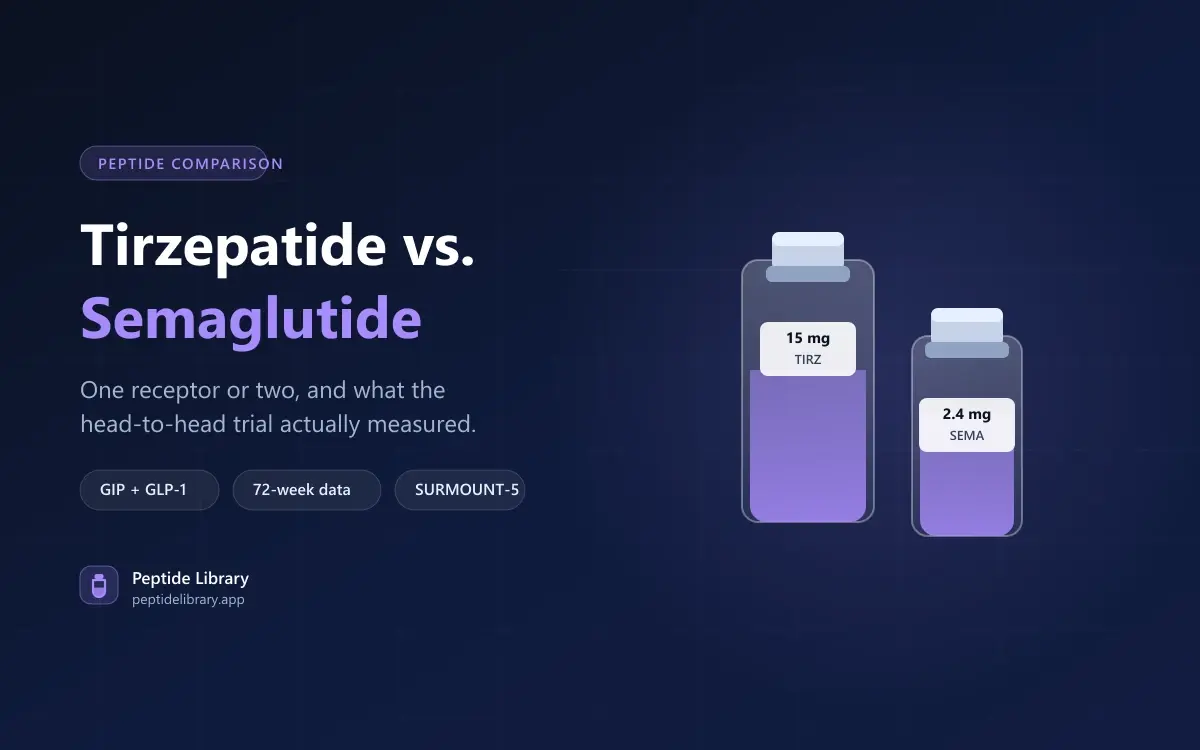
Semaglutide activates one receptor. Tirzepatide activates two. That single structural difference is the whole story, and in the first trial to compare them directly it came out as 20.2% versus 13.7% mean body-weight reduction at 72 weeks.
Both are incretin mimetics given as a weekly subcutaneous injection, and the two are constantly discussed as if they were interchangeable. They are not. This compares what they do, what the trial data show, and how they differ in practice.
These are prescription medicines. The figures below are published clinical-trial data reported for reference. They are not dosing guidance, and nothing here should be used to self-administer. Dose selection, titration, and monitoring are decisions for a licensed clinician.
The core difference: one receptor or two
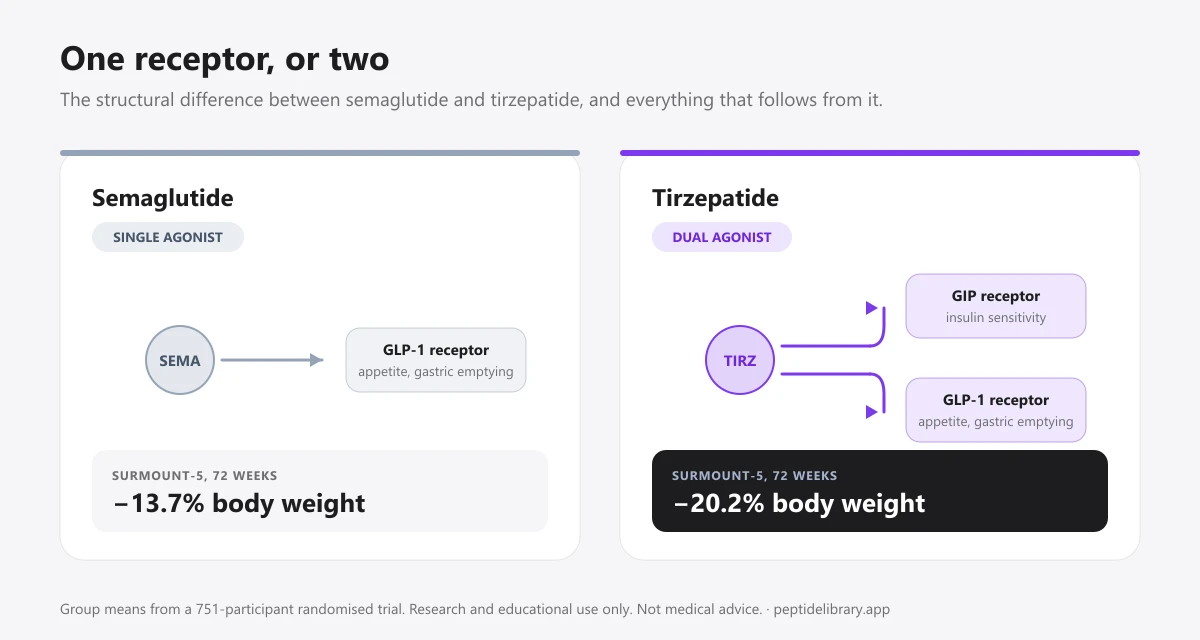
Semaglutide is a GLP-1 receptor agonist. It mimics glucagon-like peptide-1, a gut hormone released after eating that slows gastric emptying, prompts insulin release when glucose is elevated, and reduces appetite signalling.
Tirzepatide is a dual GIP and GLP-1 receptor agonist. It does everything semaglutide does and adds glucose-dependent insulinotropic polypeptide. GIP appears to improve insulin sensitivity and may soften the nausea that limits how far GLP-1 activity can be pushed — which is part of why tirzepatide tolerates a higher effective ceiling.
Head-to-head comparison
Tirzepatide | Semaglutide | |
|---|---|---|
Receptors | GIP + GLP-1 (dual) | GLP-1 only |
Administration | Weekly subcutaneous | Weekly subcutaneous |
Half-life | About 5 days | About 7 days |
Trial doses compared | 10 mg or 15 mg | 1.7 mg or 2.4 mg |
Mean weight change, 72 wk | −20.2% | −13.7% |
Reached ≥25% loss | 31.6% | 16.1% |
Main tolerability issue | GI: nausea, diarrhoea | GI: nausea, vomiting |
What SURMOUNT-5 actually measured
SURMOUNT-5 randomised 751 adults with obesity, or overweight with a weight-related complication, to the maximum tolerated dose of either drug for 72 weeks. Tirzepatide participants took 10 mg or 15 mg weekly; semaglutide participants took 1.7 mg or 2.4 mg weekly.
Mean body-weight reduction: 20.2% on tirzepatide versus 13.7% on semaglutide.
Absolute loss: 22.8 kg versus 15.0 kg.
Participants reaching at least 25% loss: 31.6% versus 16.1%.
Result: tirzepatide was superior on the primary endpoint and on all key secondary endpoints.
Superior on average is not the same as superior for everyone. These are group means across 751 people, and the response range within each arm was wide. A trial tells you which way the odds lean, not what any individual will experience.
Half-life and why the schedule is weekly
Both molecules are engineered for a long half-life — roughly 5 days for tirzepatide and 7 for semaglutide — which is what makes once-weekly dosing viable. Both take four to five weeks at a given dose to reach steady state, so the effect of any change is not fully visible for about a month.
The practical consequence is that neither is a fast-feedback compound. Judging a change after a few days measures noise.
Side effects: the same category, different intensity
Both are dominated by gastrointestinal effects — nausea, diarrhoea, vomiting, constipation — which are most pronounced during titration and settle as the dose stabilises. Both carry a boxed warning for thyroid C-cell tumours based on rodent data, and both are contraindicated in anyone with a personal or family history of medullary thyroid carcinoma or MEN2.
The reconstitution question
Research-grade vials of either compound arrive lyophilised and have to be reconstituted, which is where most arithmetic errors happen. The volume of bacteriostatic water you add does not change how much peptide is in the vial — it only sets the concentration, and therefore how many syringe units one dose works out to.
The reconstitution calculator converts vial size, diluent volume, and target dose into units, and the bacteriostatic water guide covers the storage rules that decide how long a mixed vial stays usable.
What the trial did not settle
A single trial answers a narrow question well and everything else poorly. SURMOUNT-5 establishes that tirzepatide produced greater mean weight reduction over 72 weeks in this population. It does not establish several things it is routinely quoted for.
Cardiovascular outcomes. Weight change is a surrogate endpoint. Semaglutide has separate dedicated cardiovascular outcome data that this trial neither replicates nor supersedes.
Durability past 72 weeks. The trial stopped there. What happens on continued treatment, and what happens on stopping, are different questions.
Which drug suits a given person. Comorbidities, tolerability, prior response, and access all bear on that, and a group mean speaks to none of them.
Anything about research-grade material. The trial used pharmaceutical product at controlled doses. It says nothing about the purity or content of a vial bought elsewhere.
Why the milligram numbers are not comparable
The most common error in comparing these two is treating milligrams as a shared scale. They are not. Potency per milligram is a property of the molecule, so 15 mg of tirzepatide and 2.4 mg of semaglutide are both top-of-range doses that took months of gradual escalation to reach.
Reading "15 versus 2.4" as though tirzepatide were six times stronger is meaningless. The only meaningful comparison is where a dose sits within its own approved range, and both arms of SURMOUNT-5 were at or near the top of theirs — which is what makes the comparison a fair one.
This matters practically when reading vendor listings. A research vial labelled in milligrams tells you the mass in the vial and nothing about equivalence between compounds. Concentration and dose have to be worked out per compound, every time.
Frequently asked questions
Is tirzepatide just a stronger semaglutide?
No — it is a different molecule with an additional receptor target, not a higher dose of the same thing. The milligram numbers are not comparable between them: 15 mg of tirzepatide and 2.4 mg of semaglutide are both top-of-range doses.
Why do the milligram amounts differ so much?
Potency per milligram differs between molecules. Comparing 15 mg to 2.4 mg tells you nothing useful; what matters is where each sits in its own approved range.
Do both need refrigeration?
Commercial pens are refrigerated until first use. A reconstituted research vial belongs at 2–8 °C and is bounded by the shorter of the peptide stability window and the 28-day limit on the bacteriostatic water.
Research and educational use only. Peptide Library is an independent research and comparison platform and does not sell peptides. Nothing here is medical advice, dosing guidance, or a recommendation to administer any substance to a person or an animal. Consult a licensed clinician for anything concerning human health.
Sources
- 1. Tirzepatide as Compared with Semaglutide for the Treatment of Obesity (SURMOUNT-5) — New England Journal of Medicine (2025) Source PubMed
- 2. SURMOUNT-5: Greater Loss of Weight and Waist Circumference With Tirzepatide Than Semaglutide — American College of Cardiology Source
- 3. Improved health-related quality of life with tirzepatide versus semaglutide in adults with obesity or overweight from the SURMOUNT-5 trial — Diabetes, Obesity and Metabolism (2026) Source PubMed
Author
Peptide Library Editorial
Editorial content from Peptide Library. Research and educational use only. Not medical advice.
Related articles
Related peptides
Related tools
Research smarter with Peptide Library.
Compare peptides, review vendor data, and use research calculators in one place.
Explore the LibraryResearch and educational use only. Not medical advice. Peptide Library does not sell peptides.