Peptide Research
Survodutide: The Other Glucagon Dual Agonist
Survodutide pairs GLP-1 with the glucagon receptor — a different combination from tirzepatide, and one that puts it closer to retatrutide without the third target.
Peptide Library Editorial · April 3, 2026 · 3 min read
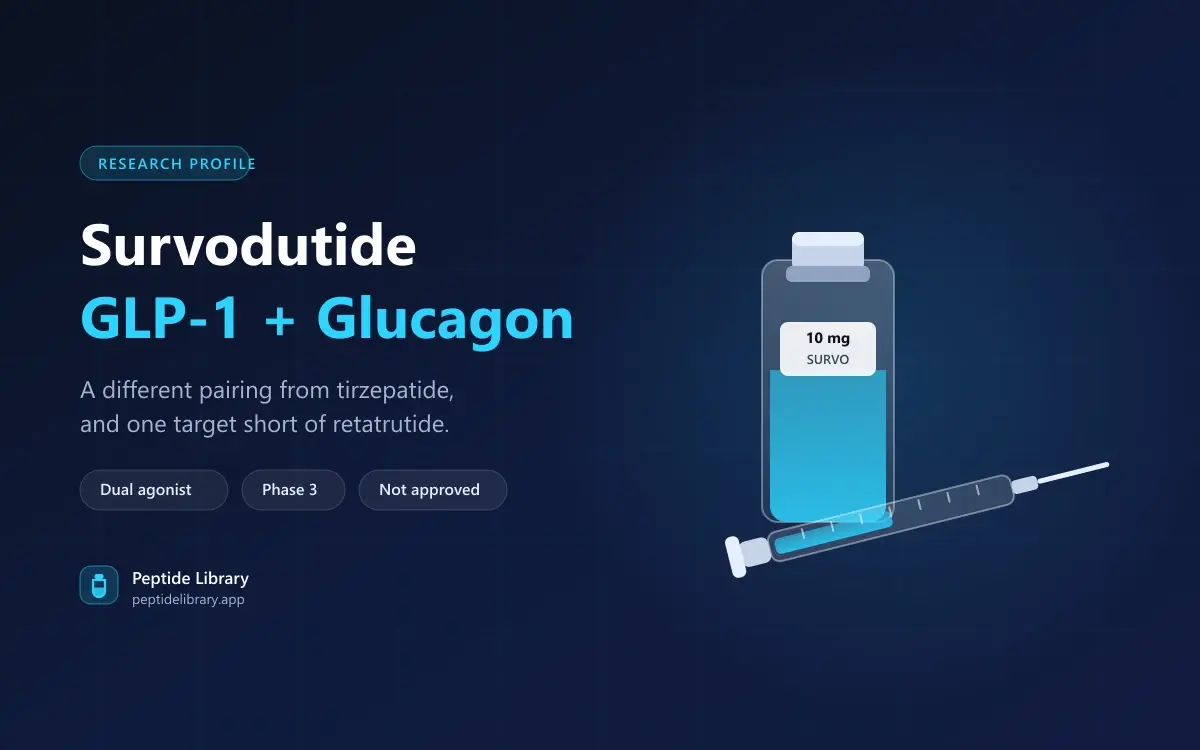
Survodutide is a dual agonist at the GLP-1 and glucagon receptors. That pairing is what distinguishes it: tirzepatide pairs GLP-1 with GIP, and survodutide pairs it with glucagon instead.
It is investigational, with phase 3 programmes ongoing, and has no approval anywhere.
Investigational, not approved. Survodutide has no approved indication and no established dose. Everything here is trial-stage information reported for reference, and material sold as research-grade sits outside the regulated supply chain entirely.
Where it sits among the incretin drugs
Compound | Receptors | Status |
|---|---|---|
Semaglutide | GLP-1 | Approved |
Tirzepatide | GIP + GLP-1 | Approved |
Survodutide | GLP-1 + glucagon | Phase 3 |
Retatrutide | GIP + GLP-1 + glucagon | Phase 3 |
Read down that table and the design logic is visible. GIP and glucagon are two different additions to the same GLP-1 base, and retatrutide is the attempt to have both.
What the glucagon receptor contributes
GLP-1 works mainly on the intake side — appetite, gastric emptying, insulin response. Glucagon receptor agonism works on expenditure, increasing energy use.
Pairing an appetite mechanism with an expenditure mechanism is the rationale for both survodutide and retatrutide. It also introduces the same considerations: glucagon raises hepatic glucose output, which runs counter to what a diabetes drug conventionally aims for, and heart rate effects are tracked in trial reporting. The retatrutide side effects guide covers that tension in more detail.
Liver disease as an indication
Survodutide has been studied not only for obesity but for metabolic dysfunction-associated steatotic liver disease — the condition previously called NASH.
That focus is a reasonable consequence of the mechanism, since glucagon receptor activity acts directly on the liver. It also means some of the trial evidence addresses a different endpoint from weight, which is worth noting when comparing headline figures across compounds.
Comparing a liver-histology endpoint against a body-weight endpoint tells you very little. When reading across these compounds, check that the numbers being compared are measuring the same thing over the same duration — they frequently are not.
The vial math
Research vials arrive lyophilised, and the arithmetic is the same as any other injectable peptide.
Vial | BAC water | Concentration | 1 mg | 3 mg | 6 mg |
|---|---|---|---|---|---|
10 mg | 2 mL | 5 mg/mL | 20 units | 60 units | Over one barrel |
10 mg | 3 mL | 3.33 mg/mL | 30 units | 90 units | Over one barrel |
10 mg | 5 mL | 2 mg/mL | 50 units | Over one barrel | Over one barrel |
The peptide calculator converts any vial and target into units.
Storage
Storage is the same as any reconstituted vial: 2–8 °C, protected from light, never frozen, and bounded by the shorter of peptide stability and the 28-day limit on bacteriostatic water. The bacteriostatic water guide covers the detail.
Frequently asked questions
Is survodutide approved?
No. It is in phase 3 trials with no approval in any major jurisdiction.
How does it differ from retatrutide?
Retatrutide adds GIP as a third target. Survodutide is GLP-1 plus glucagon only. No head-to-head trial has compared them.
Why is it studied for liver disease?
Glucagon receptors are highly expressed in the liver, so a glucagon-containing agonist has a direct rationale there that a pure incretin drug does not.
Research and educational use only. Peptide Library is an independent research and comparison platform and does not sell peptides. Nothing here is medical advice, dosing guidance, or a recommendation to administer any substance to a person or an animal. Consult a licensed clinician for anything concerning human health.
Sources
Author
Peptide Library Editorial
Editorial content from Peptide Library. Research and educational use only. Not medical advice.
Related articles
Related peptides
Related tools
Research smarter with Peptide Library.
Compare peptides, review vendor data, and use research calculators in one place.
Explore the LibraryResearch and educational use only. Not medical advice. Peptide Library does not sell peptides.