Peptide Guides
Bacteriostatic Water (BAC Water): What It Is, Uses & How Much to Add
Bacteriostatic water is sterile water with 0.9% benzyl alcohol, and that preservative is what makes a peptide vial re-enterable for 28 days. Here is how much to add, how to work out syringe units, and the storage rules that decide when a vial is done.
Peptide Library Editorial · August 29, 2026 · 12 min read
Bacteriostatic water, usually shortened to BAC water, is sterile water with 0.9% benzyl alcohol added as a preservative. That preservative is the whole point. It is what lets you puncture the same vial again and again for up to 28 days instead of discarding it after a single draw, and it is why bacteriostatic water — not plain sterile water — is the default diluent for reconstituting a multi-dose peptide vial.
Two questions cause almost every problem people run into: how much to add and how long the vial stays usable. This guide answers both — with the arithmetic, a reconstitution chart, the storage rules, and the differences between bacteriostatic water, sterile water, and "reconstitution solution" that get confused constantly.
Research and educational use only. This article explains handling, chemistry, and arithmetic. It is not medical advice, not dosing guidance, and not a recommendation to administer anything to a person or an animal. Peptide Library does not sell peptides.
What is bacteriostatic water (BAC water)?
Bacteriostatic Water for Injection, USP is sterile, non-pyrogenic water containing 0.9% (9 mg/mL) benzyl alcohol as a bacteriostatic preservative. It is supplied in a multiple-dose container specifically so that repeated withdrawals can be made to dilute or dissolve drugs for injection.
The word "bacteriostatic" is doing precise work here. Benzyl alcohol inhibits the growth of bacteria; it does not sterilise. If you introduce contamination on a dirty needle, bacteriostatic water slows what happens next — it does not undo it. Sterile technique still does the heavy lifting; the preservative just buys you a re-entry window.
What is actually in the vial
Base: Sterile Water for Injection, USP.
Preservative: 0.9% benzyl alcohol, or 9 mg per mL.
pH: about 5.7, with an allowed range of 4.5 to 7.0 — mildly acidic, which suits most peptides.
Container: multiple-dose vials, most commonly 10 mL and 30 mL.
Nothing else: no buffers, no antimicrobial agents beyond the benzyl alcohol, no tonicity adjusters.
Neonatal contraindication. Because of the potential toxicity of benzyl alcohol in newborns, the manufacturer label states that solutions containing benzyl alcohol must not be used in that population. Benzyl alcohol volume also becomes a real consideration in any large-volume use.
Bacteriostatic water vs. sterile water vs. reconstitution solution
These three look identical in the vial. The difference is entirely in what has been added — and it decides whether you get one draw or a month of them.
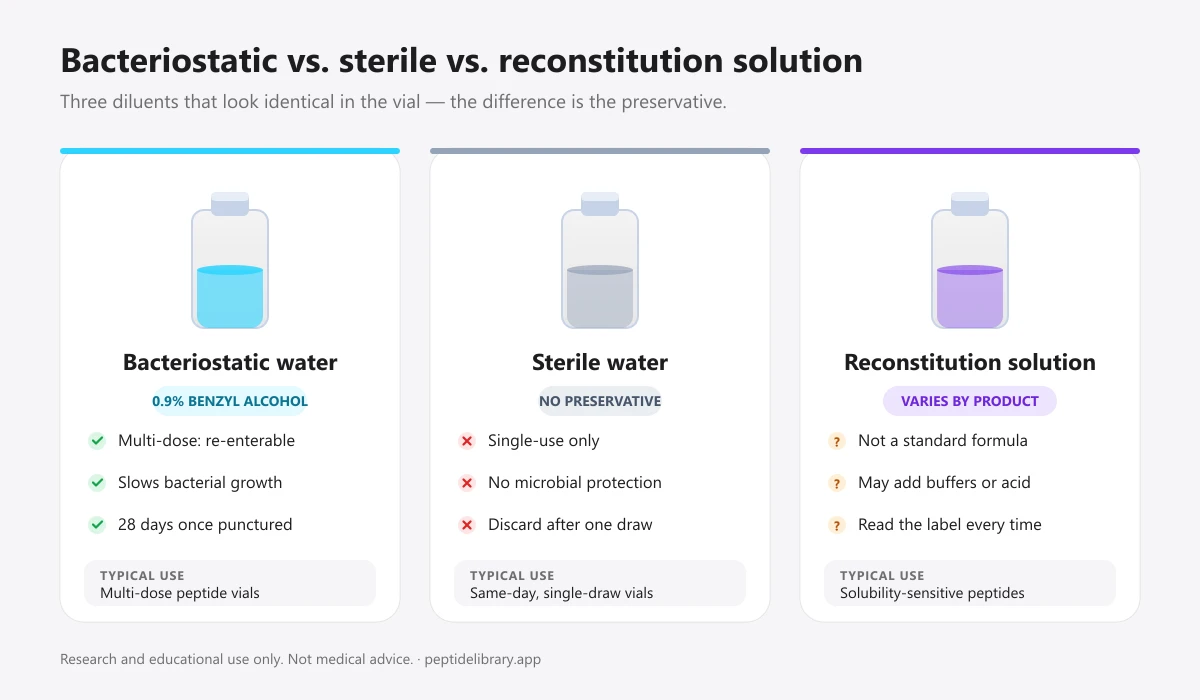
Bacteriostatic water | Sterile water | Reconstitution solution | |
|---|---|---|---|
Preservative | 0.9% benzyl alcohol | None | Varies by product |
Re-entry | Multi-dose, up to 28 days | Single use — one draw | Depends on the formulation |
Protects against | Bacterial growth between draws | Nothing after opening | Depends on the additives |
Typical use | Multi-dose peptide vials | Same-day, single-draw prep | Solubility-sensitive peptides |
Main pitfall | Assuming it sterilises | Re-entering the vial anyway | Assuming it is preserved |
Is bacteriostatic water the same as sterile water?
No. Both are sterile when sealed, but sterile water contains no preservative, which makes it a single-use diluent. Once its stopper is punctured there is nothing in the vial slowing microbial growth, so it should not be re-entered. Bacteriostatic water is the one designed to be used repeatedly.
Is reconstitution solution the same as bacteriostatic water?
Not necessarily, and this is the trap. "Reconstitution solution" is a marketing category rather than a defined USP product. Some are simply bacteriostatic water under a different label; others add buffers or acidifiers to help stubborn peptides dissolve, and some contain no preservative at all. Read the actual ingredient list on the bottle every time — the name tells you nothing about whether the vial can be re-entered next week.
How much bacteriostatic water to mix with a peptide vial
There is no single correct volume, and this is the single most common misunderstanding. The amount of peptide in the vial is fixed — a 5 mg vial contains 5 mg whether you add 1 mL or 3 mL. All the water decides is the concentration, which in turn decides how many syringe units one dose works out to.
The practical rule: add enough water that your intended dose lands somewhere readable on the syringe. A dose that works out to 4 units is hard to measure accurately; the same dose at half the concentration lands on 8 units and is far easier to draw consistently.
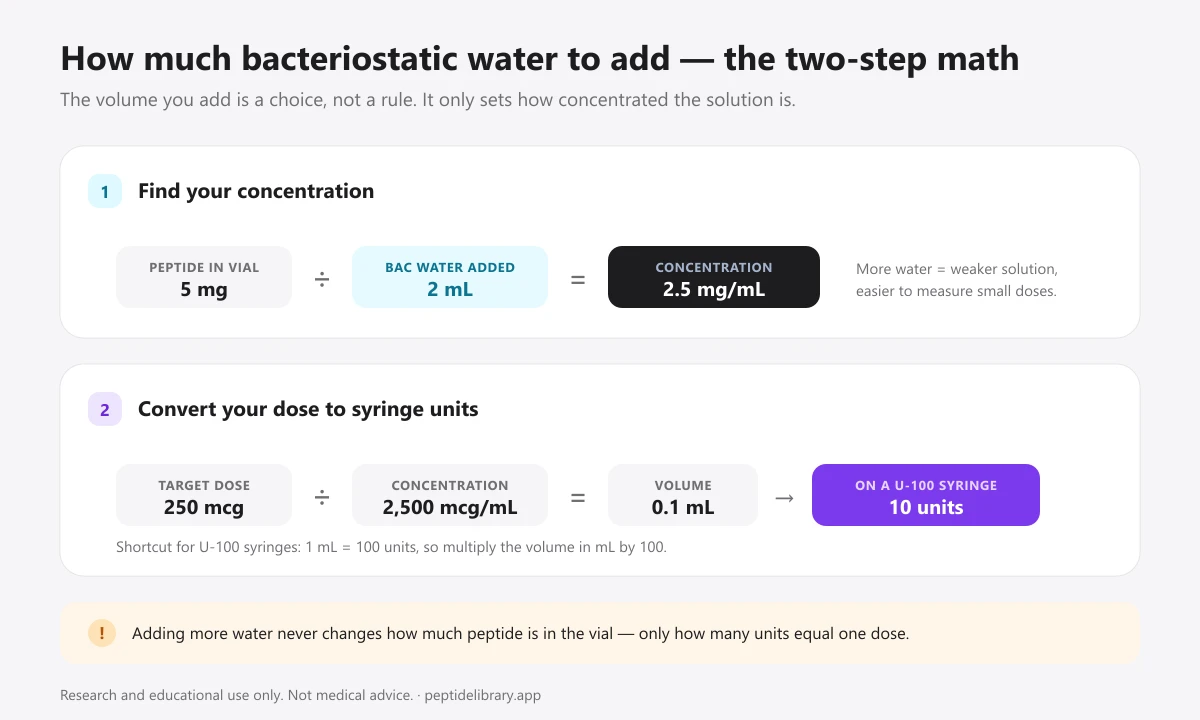
The only formula you need
Concentration: milligrams in the vial ÷ millilitres of bacteriostatic water = mg/mL. A 5 mg vial with 2 mL added is 2.5 mg/mL.
Volume: your dose ÷ the concentration = the volume to draw. Convert both to the same unit first — 2.5 mg/mL is 2,500 mcg/mL, so a 250 mcg dose is 0.1 mL.
Units: on a U-100 insulin syringe, 1 mL = 100 units. Multiply millilitres by 100. That 0.1 mL is 10 units.
Peptide reconstitution chart
Common vial sizes against common water volumes. The last column is the one worth memorising — it tells you what a single 10-unit mark on a U-100 syringe is actually worth.
Vial size | BAC water added | Concentration | Per 10 units (0.1 mL) |
|---|---|---|---|
5 mg | 1 mL | 5 mg/mL | 500 mcg |
5 mg | 2 mL | 2.5 mg/mL | 250 mcg |
5 mg | 3 mL | 1.67 mg/mL | 167 mcg |
10 mg | 1 mL | 10 mg/mL | 1,000 mcg |
10 mg | 2 mL | 5 mg/mL | 500 mcg |
10 mg | 3 mL | 3.33 mg/mL | 333 mcg |
15 mg | 3 mL | 5 mg/mL | 500 mcg |
30 mg | 3 mL | 10 mg/mL | 1,000 mcg |
If you would rather not do this by hand for every vial, the peptide reconstitution calculator takes the vial size, the water volume, and the target dose and returns the syringe units directly.
Worked examples
A 10 mg BPC-157 vial. Add 2 mL and you have 5 mg/mL, where 250 mcg is only 5 units — measurable, but unforgiving of small errors. Add 3 mL instead and you have 3.33 mg/mL, where the same 250 mcg lands at 7.5 units, and 500 mcg at 15 units. For small doses, more water is the friendlier choice. See the BPC-157 research profile for handling notes specific to that peptide.
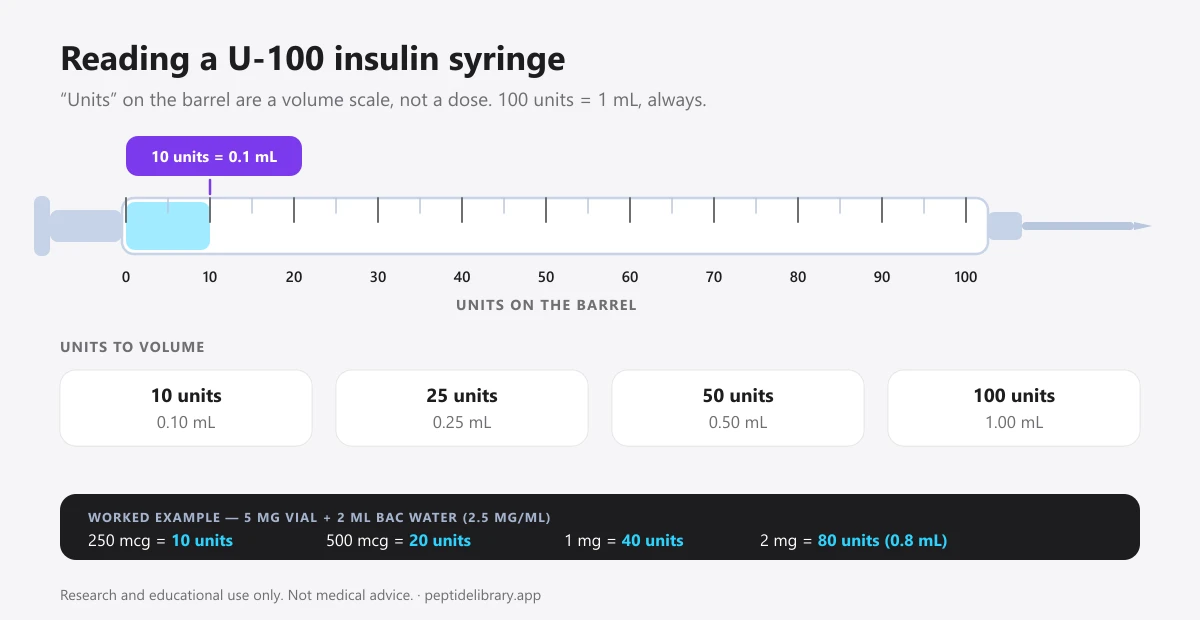
A 5 mg semaglutide vial. Add 2 mL for 2.5 mg/mL. At that concentration 0.25 mg is 10 units, 0.5 mg is 20 units, and 1 mg is 40 units — the whole vial is 200 units of solution. Semaglutide and tirzepatide vials are frequently reconstituted at these volumes precisely because the resulting numbers are round.
A 10 mg tirzepatide vial. Add 2 mL for 5 mg/mL, and 2.5 mg works out to 0.5 mL — 50 units, half the barrel. Add 4 mL instead and the same 2.5 mg becomes the full 100-unit barrel, which is more syringe than most people want to push at once.
These are arithmetic examples showing how concentration works. They are not dose recommendations. Compounds such as semaglutide and tirzepatide are prescription medicines, and what any individual should take is a decision for a licensed clinician, not a chart.
Reading a U-100 insulin syringe
The numbers printed on an insulin syringe are units of volume, not units of drug. On a U-100 syringe the barrel holds 1 mL across 100 marks — so 10 units is always 0.1 mL, 50 units is always 0.5 mL, and the peptide content of those units depends entirely on the concentration you mixed.
How to mix peptides with bacteriostatic water
Technique matters as much as volume. Lyophilised peptide is a fragile, fluffy cake sitting at the bottom of the vial, and the fastest way to damage it is to blast water straight into it.
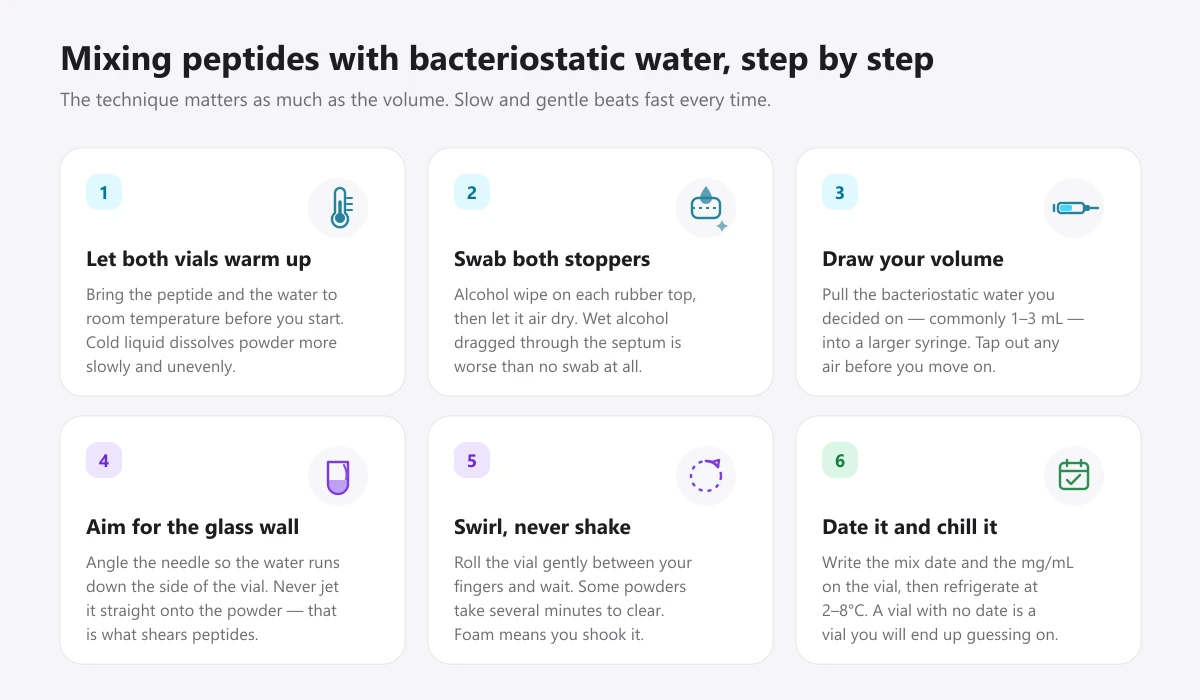
Bring both vials to room temperature. Cold powder dissolves slowly and unevenly. Published peptide-handling guidance specifically recommends letting lyophilised material warm before reconstitution to avoid moisture condensing into the unused powder.
Swab both stoppers and let them dry. Alcohol wipe on each rubber top, then wait. Dragging a needle through wet alcohol pushes it into the vial, which is worse than not swabbing at all.
Draw the volume you decided on. Use a larger syringe for this — 1 mL to 3 mL is typical — and tap out air before you go any further.
Aim the needle at the glass wall. Angle it so the water runs down the inside of the vial rather than jetting directly onto the powder. Shear force is what breaks peptide chains.
Swirl, never shake. Roll the vial gently between your fingers and be patient — some powders take several minutes to go fully clear. Foam on the surface means you were too rough.
Date the vial and refrigerate it. Write the mix date and the resulting mg/mL directly on the label. A vial with no date is a vial you will end up guessing about in three weeks.
Cloudiness, stubborn floating particles, or a solution that never fully clears is worth stopping over. A properly reconstituted peptide solution should be clear and free of visible particulate.
Does bacteriostatic water need to be refrigerated?
No — an unopened vial of bacteriostatic water is stored at controlled room temperature, 20–25 °C, not in the fridge. Refrigeration enters the picture once the water is mixed with a peptide: the reconstituted solution goes to 2–8 °C. The water on its own is happy in a cupboard, away from direct light, until its printed expiry date.

How long is bacteriostatic water good for?
Two separate clocks run, and the shorter one always wins:
Unopened: good until the expiry date printed on the vial, stored at room temperature.
After the first puncture: 28 days. CDC injection-safety guidance is that a multi-dose vial is dated when it is first opened and discarded within 28 days, unless the manufacturer specifies a different window for that product.
Never past the printed date: a beyond-use date can shorten the manufacturer expiry but can never extend it. A vial punctured three days before it expires has three days left, not 28.
This is why the date you write on the label matters more than the one printed on it. The 28-day clock starts at the first needle puncture — not at purchase, not at the expiry date.
Storing the reconstituted vial
2–8 °C, in the fridge — the door is the warmest, most temperature-swung spot; use a shelf.
Protect from light — aromatic residues in some peptides are photosensitive.
Do not freeze a reconstituted vial — freeze–thaw cycles stress peptides in solution. Freezing is for dry powder, and even then straight from the supplier.
Take the shorter window. If a peptide is only stable for 14 days in solution, 14 days is your limit. The 28-day figure describes the water, not the peptide.
Where to buy bacteriostatic water for peptides
In the United States, Bacteriostatic Water for Injection, USP is labelled "Rx only" — it is a prescription drug product, not a general retail item. Pharmacies such as CVS and Walgreens may be able to order it, but typically want a prescription, and stocking varies enormously by location. Medical and veterinary supply retailers are the more common source, and requirements differ outside the US.
Whatever the source, the vial itself should tell you it is the real thing:
Labelled Bacteriostatic Water for Injection, USP — not "sterile water", not an unqualified "reconstitution solution".
States 0.9% benzyl alcohol explicitly on the label.
Carries a lot number and expiry date printed on the vial, not just on the box.
Arrives with an intact flip cap and an unpunctured stopper.
Comes in a proper sealed vial — anything decanted into an unlabelled bottle should be discarded.
If you are pricing supplies alongside peptides, the vendor comparison tracks supply listings next to peptide pricing so you can see the real per-vial cost of a run rather than the headline number.
Five mistakes that ruin a vial
Shaking to dissolve faster. It denatures peptide and creates foam that makes accurate draws impossible. Swirl and wait.
Reusing needles between draws. The preservative slows contamination; it does not remove what a used needle carries back in. Fresh needle, every time.
Not writing the mix date on the vial. Four weeks later you will be estimating, and you will estimate generously.
Using sterile water for a multi-dose vial. It works perfectly for one draw and is a contamination risk for the seven after it.
Changing the water volume mid-vial. Topping up a partly used vial makes every previous calculation wrong and the remaining concentration unknowable. Pick a volume and commit to it.
Frequently asked questions
Can I use one bottle of bacteriostatic water for several peptides?
Yes — that is exactly what a multiple-dose container is for. Draw from the same bottle for multiple vials within the 28-day window, using a fresh needle and a freshly swabbed, dried stopper each time.
Does bacteriostatic water expire?
Yes, twice over. It carries a printed manufacturer expiry for the sealed vial, and a 28-day beyond-use date once punctured. Whichever arrives first is the one that applies.
How long does bacteriostatic water last in the fridge?
Refrigeration does not extend the 28-day window, and the water itself does not need to be refrigerated at all. What belongs in the fridge is the reconstituted peptide, at 2–8 °C.
What happens if I add too much bacteriostatic water?
Nothing is destroyed — you simply have a more dilute solution, and each dose becomes a larger number of units. The problem only becomes real at extremes: if a dose requires more than a full 100-unit barrel you are stuck splitting draws, and very large benzyl alcohol volumes carry their own concerns.
Can I reconstitute with distilled or tap water?
No. Neither is sterile or non-pyrogenic, and neither is preserved. This is not a case where a close-enough substitute exists.
Do you need a prescription for bacteriostatic water?
In the US the product is labelled "Rx only", so a pharmacy will generally require one. Availability and requirements differ by country and by supplier type.
Can I freeze a reconstituted peptide vial?
It is not recommended. Freeze–thaw cycles are a well-documented stressor for peptides in solution; peptide-handling literature recommends avoiding repeated cycles entirely. Long-term storage belongs to the lyophilised powder, not to the mixed vial.
Why is my reconstituted peptide cloudy?
Common causes are insufficient time to dissolve, agitation from shaking, a peptide that needs an acidified diluent rather than plain bacteriostatic water, or a genuine quality problem with the material. A clear solution is the expected result.
Stop doing this arithmetic in your head
Every step above is easy to get right once and hard to keep getting right across a dozen vials at different concentrations. Peptide Library keeps the parts that go wrong in one place: the reconstitution calculator converts vial size, water volume, and dose straight into syringe units; the inventory tracker records what each vial was mixed at and when, so the 28-day clock is not something you have to remember; and the peptide library holds handling and storage notes per compound.
Research and educational use only. Not medical advice. Peptide Library is an independent research and comparison platform and does not sell peptides. Nothing here is a recommendation to administer any substance to a person or an animal. Consult a licensed clinician for anything concerning human health.
Sources
- 1. Bacteriostatic Water for Injection, USP — prescribing information — Hospira, Inc. / DailyMed, U.S. National Library of Medicine Source
- 2. Preventing Unsafe Injection Practices — Centers for Disease Control and Prevention Source
- 3. Safe Injection Practices Checklist — Centers for Disease Control and Prevention Source
- 4. Single-Dose or Multi-Dose? Not All Vials Are Created Equal — Centers for Disease Control and Prevention Source
- 5. Hoofnagle AN, et al. Recommendations for the generation, quantification, storage and handling of peptides used for mass spectrometry-based assays — Clinical Chemistry 62(1):48–69 (2016) DOI: 10.1373/clinchem.2015.250563 Source PubMed
Author
Peptide Library Editorial
Editorial content from Peptide Library. Research and educational use only. Not medical advice.
Related articles
Related peptides
Related tools
Research smarter with Peptide Library.
Compare peptides, review vendor data, and use research calculators in one place.
Explore the LibraryResearch and educational use only. Not medical advice. Peptide Library does not sell peptides.