Peptide Guides
Retatrutide Dosage: What the Phase 2 Trial Used, and the Reconstitution Math
Retatrutide is a triple agonist still in trials — it has no approved dose. Here is the escalation schedule the phase 2 study used, what it produced at 48 weeks, and how the reconstitution arithmetic works.
Peptide Library Editorial · May 5, 2026 · 4 min read
Retatrutide has no approved dose, because it is not an approved drug. It is an investigational triple agonist — GIP, GLP-1, and glucagon — and every number associated with it comes from clinical trials rather than a label.
That distinction matters more here than with tirzepatide or semaglutide. What follows is the escalation schedule the published phase 2 trial used and the arithmetic for converting milligrams into syringe units.
These are prescription medicines. The figures below are published clinical-trial data reported for reference. They are not dosing guidance, and nothing here should be used to self-administer. Dose selection, titration, and monitoring are decisions for a licensed clinician.
What retatrutide is
Retatrutide adds a third target to the dual-agonist approach: the glucagon receptor. Glucagon receptor activity increases energy expenditure, where GIP and GLP-1 act mainly on appetite and insulin response. The combination is why trial results have drawn so much attention.
The doses used in the phase 2 trial
The NEJM phase 2 trial randomised 338 adults across placebo and four retatrutide arms, escalating gradually rather than starting at target. Reported least-squares mean weight change at 48 weeks:
Trial arm | Mean weight change at 48 weeks |
|---|---|
Placebo | −2.1% |
1 mg | −8.7% |
4 mg | −17.1% |
8 mg | −22.8% |
12 mg | −24.2% |
In the 12 mg group, 100% of participants reached at least 5% reduction, 93% reached 10%, 83% reached 15%, and 26% reached 30% or more.
Escalation was gradual and supervised. Participants did not begin at 8 or 12 mg. Doses were stepped up over months under clinical monitoring, and gastrointestinal effects were dose-related. The endpoint numbers describe the top of a slow ramp, not a starting point.
Reconstitution: turning milligrams into units
Research vials arrive lyophilised. The powder mass is fixed; the bacteriostatic water you add only decides the concentration.
Concentration: mg in the vial ÷ mL of water = mg/mL.
Volume: target dose ÷ concentration = mL to draw.
Units: on a U-100 syringe, 1 mL = 100 units, so multiply mL by 100.
Reconstitution chart for a 10 mg vial
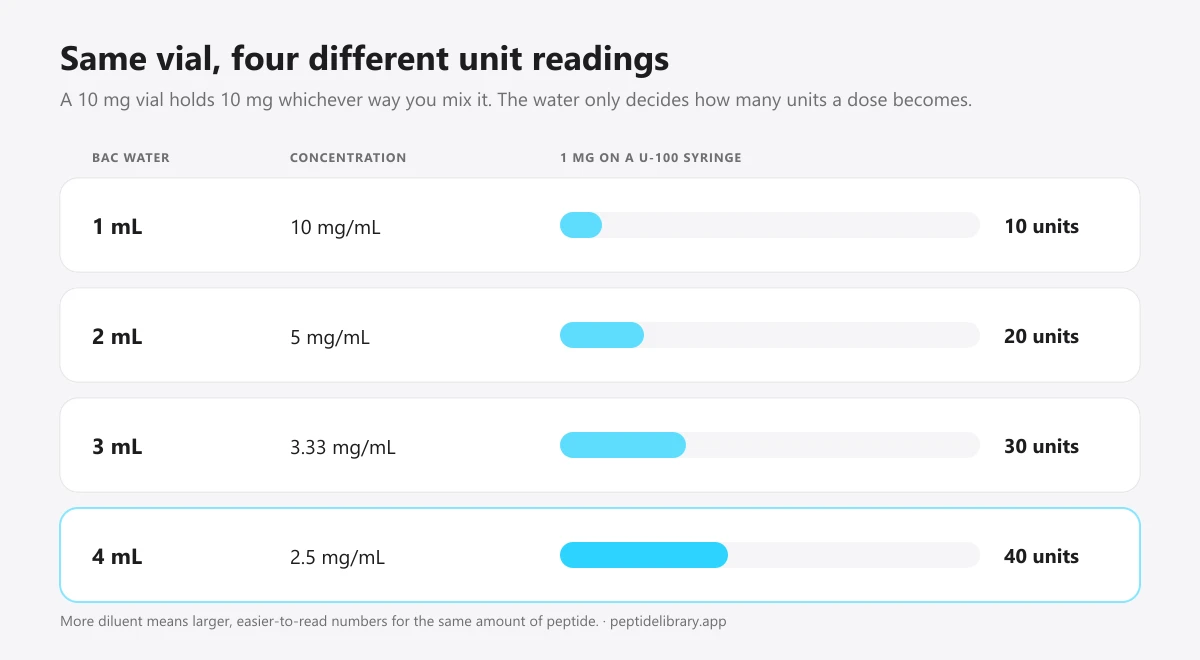
BAC water added | Concentration | 1 mg equals | 2 mg equals |
|---|---|---|---|
1 mL | 10 mg/mL | 10 units | 20 units |
2 mL | 5 mg/mL | 20 units | 40 units |
3 mL | 3.33 mg/mL | 30 units | 60 units |
4 mL | 2.5 mg/mL | 40 units | 80 units |
More water means larger, easier-to-read unit numbers for the same dose. At 1 mL a 1 mg dose is a cramped 10 units; at 3 mL it is a comfortable 30. The peptide calculator does this conversion for any vial size.
Storage
Unmixed powder: as supplied, cold and dark; it is the stable form.
After reconstitution: 2–8 °C, protected from light, never frozen.
Time limit: the shorter of the peptide stability window and the 28-day limit on bacteriostatic water once punctured. See the bacteriostatic water guide.
What the glucagon receptor adds
GIP and GLP-1 both work largely on the intake side — appetite signalling, gastric emptying, insulin response. Glucagon receptor agonism works on the other side of the equation, increasing energy expenditure.
That is the mechanistic argument for a triple agonist, and it is also why the compound is watched carefully. Glucagon receptor activity raises questions that a pure incretin drug does not — effects on hepatic glucose output and heart rate among them, both of which trial reporting has tracked.
Tolerability in the trial
Adverse effects were predominantly gastrointestinal — nausea, diarrhoea, vomiting, constipation — and were dose-related, which is precisely why the protocol escalated slowly rather than starting at target. Dose-related also means the tolerability profile at 12 mg is not the profile at 1 mg.
This is the part most summaries omit when quoting the −24.2% figure. That number is inseparable from the escalation schedule and the monitoring that accompanied it.
A useful habit when reading any trial summary: check whether the headline efficacy number and the tolerability data came from the same arm at the same timepoint. They frequently do not, and the resulting picture is more flattering than the trial.
Where retatrutide stands
Phase 2 results are a signal, not an approval. Phase 3 programmes are where efficacy is confirmed at scale and where less common adverse effects surface — the stage at which a meaningful number of candidate drugs fail or acquire restrictions.
Until that reports, anything sold as retatrutide is research material outside any regulated supply chain, with no guarantee of identity, purity, or content. The guide to reading a certificate of analysis covers what can and cannot be verified about such material.
Frequently asked questions
Is there an approved retatrutide dose?
No. It remains investigational, and phase 3 programmes are ongoing. Every figure here is trial data, not a label.
How does it compare with tirzepatide?
Retatrutide adds glucagon receptor activity to tirzepatide's GIP and GLP-1. Cross-trial comparisons are unreliable — different populations, durations, and endpoints — so the honest answer is that no head-to-head trial has reported. See the tirzepatide vs semaglutide comparison for how much a genuine head-to-head can change the picture.
Why do dosing charts online disagree?
Because there is no authoritative schedule to agree on. Charts circulating online are extrapolations from the trial arms, not guidance, and they vary because their authors made different assumptions.
Research and educational use only. Peptide Library is an independent research and comparison platform and does not sell peptides. Nothing here is medical advice, dosing guidance, or a recommendation to administer any substance to a person or an animal. Consult a licensed clinician for anything concerning human health.
Sources
- 1. Jastreboff AM, et al. Triple-Hormone-Receptor Agonist Retatrutide for Obesity — A Phase 2 Trial — New England Journal of Medicine (2023) DOI: 10.1056/NEJMoa2301972 Source PubMed
- 2. Bacteriostatic Water for Injection, USP — prescribing information — Hospira, Inc. / DailyMed, U.S. National Library of Medicine Source
Author
Peptide Library Editorial
Editorial content from Peptide Library. Research and educational use only. Not medical advice.
Related articles
Related peptides
Related tools
Research smarter with Peptide Library.
Compare peptides, review vendor data, and use research calculators in one place.
Explore the LibraryResearch and educational use only. Not medical advice. Peptide Library does not sell peptides.