Peptide Research
CagriSema: Two Molecules in One Injection
CagriSema is a fixed combination of cagrilintide, an amylin analogue, and semaglutide. It is also the rare peptide combination that was actually tested against its own components — and the trials show what that measurement is worth.
Peptide Library Editorial · June 23, 2026 · 6 min read
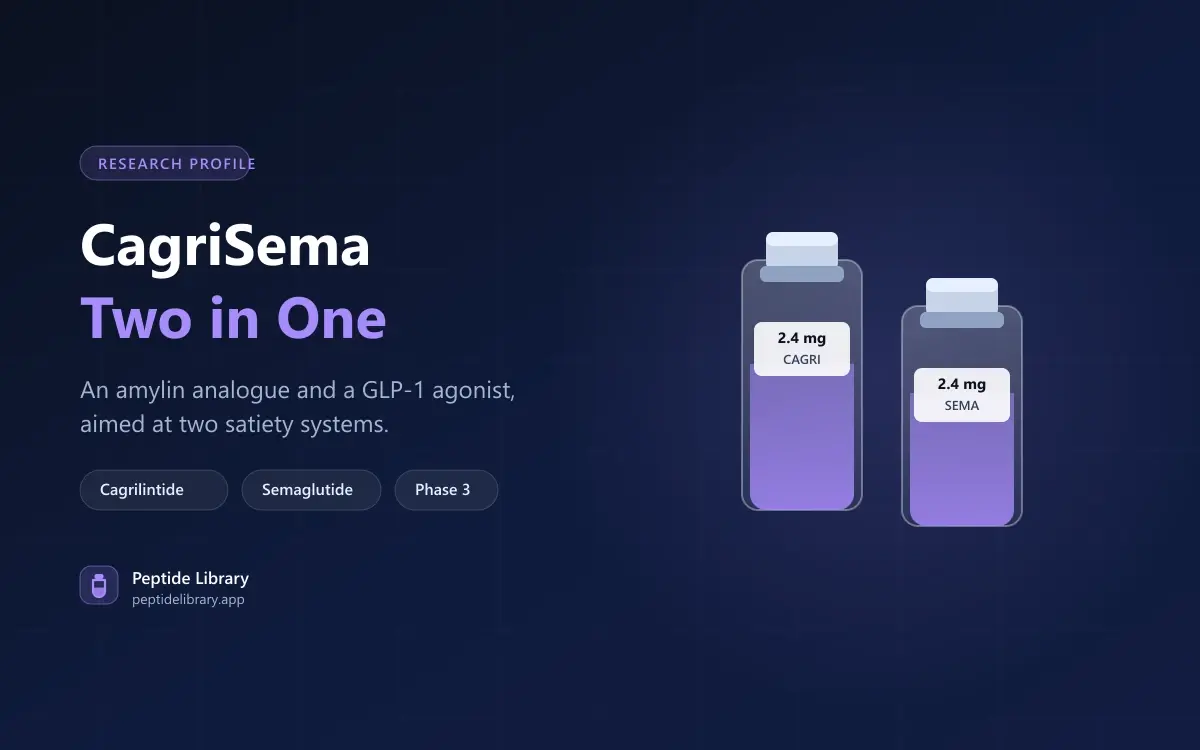
CagriSema is two separate molecules delivered together: cagrilintide, a long-acting amylin analogue, and semaglutide, a GLP-1 receptor agonist. It is a fixed-dose combination rather than a new compound.
That distinguishes it from the multi-agonist approach. Tirzepatide and retatrutide are single molecules hitting several receptors; CagriSema is two molecules each hitting their own.
Investigational. CagriSema has no approved indication and no established dose. Everything here is trial-stage information reported for reference, and nothing is dosing guidance.
Two different satiety systems
Amylin is a hormone co-secreted with insulin by pancreatic beta cells. It slows gastric emptying and promotes satiety through pathways in the hindbrain — related to, but distinct from, how GLP-1 acts (Fischer and Borner 2026).
Component | Class | Acts through |
|---|---|---|
Cagrilintide | Long-acting amylin analogue | Amylin/calcitonin receptor pathways |
Semaglutide | GLP-1 receptor agonist | GLP-1 receptor signalling |
The rationale is that two satiety mechanisms acting together produce more effect than either alone — the same combination logic behind the multi-agonists, arrived at by a different route.
Why this combination is different from the rest
Almost every peptide combination discussed in research communities rests on the argument made above: two complementary mechanisms should beat one. That argument is cheap. What is expensive, and rare, is testing it.
CagriSema was tested. REDEFINE 1 randomised 3,417 adults across four arms — the combination, semaglutide alone, cagrilintide alone, and placebo — for 68 weeks (Verma 2026). That design is the entire point: with monotherapy arms alongside the combination, the trial can answer whether combining actually adds anything, rather than assuming it.
REDEFINE 5 put the question even more directly, randomising 331 adults in Japan and Taiwan to the combination or to semaglutide alone for 68 weeks (Yamauchi 2026). Mean bodyweight change at week 68 was −18.4% with the combination versus −11.9% with semaglutide alone — an estimated treatment difference of 6.5 percentage points (95% CI −8.4 to −4.6; p<0.0001).
That 6.5-point figure is worth sitting with. It is a real, measured contribution from adding the second component — and it exists only because someone ran the comparator arm. No combination in the peptide stacks directory has a number like it, because none of them has been tested this way. The combinations there are graded on their components' evidence for exactly that reason.
This is the standard other combinations are not held to. When a product page claims a blend is greater than the sum of its parts, the question to ask is the one REDEFINE 5 answered: compared with what? A combination that has never been run against its own best component has not demonstrated synergy, however plausible the mechanism.
Combination versus multi-agonist
This is the genuinely interesting design question, and both approaches have real trade-offs.
A single multi-agonist molecule means one pharmacokinetic profile and one manufacturing process, but the receptor ratio is fixed at whatever the molecule does.
A fixed combination allows each component to be dosed and titrated on its own scale, at the cost of two molecules with two profiles in one injection.
It is the same trade-off that appears in far simpler form with the GLOW and KLOW blends: combining components fixes their ratio unless the format lets you vary them independently.
What the trials found beyond weight
REDEFINE 1's secondary and post-hoc analyses looked at blood pressure, and the results were substantial. Systolic pressure fell 10.9 mmHg with the combination against 2.8 mmHg with placebo over 68 weeks; diastolic fell 5.4 mmHg against 1.7 mmHg. Some 63.0% of participants on the combination reached blood-pressure targets against 32.0% on placebo, and among those taking antihypertensive medication during the study, 39.6% in the combination group reduced or stopped it, compared with 18.8% on placebo (Verma 2026).
Those are cardiometabolic outcomes rather than a number on a scale, and they are the kind of endpoint that separates a drug programme from a supplement claim.
A systematic review with GRADE assessment of the randomised evidence has also been published, which is the appropriate next thing to read once individual trials start accumulating (Khan 2026).
Reported adverse effects
Adverse events in REDEFINE 5 were reported by 87% of participants on the combination and 84% on semaglutide alone. The most common were gastrointestinal — 53% versus 51% respectively (Yamauchi 2026).
Two things follow. Gastrointestinal effects are characteristic of this drug class rather than of the combination specifically, and in that trial adding cagrilintide did not markedly increase them over semaglutide alone. But an adverse-event rate near 85% in both arms is not a minor footnote, and discontinuation ran at 10% and 6% respectively.
Research-market versions are not the trialled product. Everything above describes a specific fixed-dose pharmaceutical formulation administered under trial conditions with titration and monitoring. Material sold as "CagriSema" on the research market is not that formulation, has not been through those controls, and none of these results transfer to it.
Where the approval stands
CagriSema remains investigational. It has completed phase 3 trials but has no approved indication, and the programme has drawn attention partly because early results were weighed against expectations set by tirzepatide.
Watch for cross-trial comparison when reading about it. Comparing a CagriSema result against a tirzepatide result from a different trial, population, and duration is not a like-for-like comparison, however tempting the headline arithmetic. The tirzepatide vs semaglutide guide shows how much a genuine head-to-head can shift the picture.
The vial math
Research-grade material sold under this name is typically a blend, which raises the labelling problem common to all blends: is a stated milligram figure the total, or the amount of each component?
Vial (each component) | BAC water | Concentration each | 0.5 mg | 1 mg |
|---|---|---|---|---|
5 mg + 5 mg | 2 mL | 2.5 mg/mL | 20 units | 40 units |
5 mg + 5 mg | 3 mL | 1.67 mg/mL | 30 units | 60 units |
10 mg + 10 mg | 4 mL | 2.5 mg/mL | 20 units | 40 units |
Resolve the per-component masses before adding water. The BPC-157 and TB-500 guide works through why that ambiguity ruins the arithmetic, and the peptide calculator supports per-component concentrations.
Storage
Storage is the same as any reconstituted vial: 2–8 °C, protected from light, never frozen, and bounded by the shorter of peptide stability and the 28-day limit on bacteriostatic water. The bacteriostatic water guide covers the detail.
Frequently asked questions
Is CagriSema a single molecule?
No. It is a fixed combination of cagrilintide and semaglutide, unlike tirzepatide which is one molecule with two receptor targets.
Does CagriSema work better than semaglutide alone?
In REDEFINE 5 it did, by a measured margin: −18.4% bodyweight at 68 weeks versus −11.9% for semaglutide alone, a difference of 6.5 percentage points. That trial was in an East Asian population of 331 participants, so it is one result rather than the whole picture, but it is a direct head-to-head against the single component.
What is amylin?
A hormone co-secreted with insulin that slows gastric emptying and promotes satiety. Cagrilintide is a long-acting synthetic analogue of it.
What are the side effects?
Gastrointestinal effects are the most common, reported by around half of participants in trials — a characteristic of this drug class rather than of the combination in particular. Overall adverse-event rates in REDEFINE 5 were similar between the combination and semaglutide alone.
Is it approved?
No. It remains investigational, with completed phase 3 trials but no approved indication.
Why does CagriSema come up in discussions of peptide stacks?
Because it is the rare combination with trial evidence on the combination itself rather than only on its ingredients. It is the comparison case for community stacks, none of which has been tested against its own components. The peptide stacks directory grades every combination on that basis.
Research and educational use only. Peptide Library is an independent research and comparison platform and does not sell peptides. Nothing here is medical advice, dosing guidance, or a recommendation to administer any substance to a person or an animal. Consult a licensed clinician for anything concerning human health.
Sources
- 1. Yamauchi T, Becker NP, et al. Efficacy and safety of co-administered cagrilintide and semaglutide versus semaglutide alone in adults with overweight or obesity with or without type 2 diabetes in Japan and Taiwan (REDEFINE 5): a multicentre, randomised, active-controlled, phase 3a trial. Lancet Diabetes Endocrinol. 2026;14(6):450-462. — The Lancet Diabetes & Endocrinology (2026) Source PubMed
- 2. Verma S, Böttcher M, et al. CagriSema Reduces Blood Pressure in Adults With Overweight or Obesity: REDEFINE 1. Hypertension. 2026;83(2). — Hypertension (2026) Source PubMed
- 3. Khan BW, Agha SA, et al. Maximizing weight loss with cagrisema: a systematic review and GRADE-assessed meta-analysis of randomized controlled trials. Naunyn Schmiedebergs Arch Pharmacol. 2026. — Naunyn-Schmiedeberg's Archives of Pharmacology (2026) Source PubMed
- 4. Fischer SL, Borner T. Beyond GLP-1: Amylin-based pharmacotherapy and the search for better-tolerated weight-loss drugs. Pharmacol Res. 2026;232:108382. — Pharmacological Research (2026) Source PubMed
Author
Peptide Library Editorial
Editorial content from Peptide Library. Research and educational use only. Not medical advice.
Related articles
Related peptides
Research smarter with Peptide Library.
Compare peptides, review vendor data, and use research calculators in one place.
Explore the LibraryResearch and educational use only. Not medical advice. Peptide Library does not sell peptides.