Peptide Guides
BPC-157 and TB-500: Why Blended Vials Break the Usual Math
These two are constantly paired and often sold pre-blended. A blended vial is where reconstitution arithmetic quietly goes wrong, and the two literatures behind the pair are less alike than the pairing suggests.
Peptide Library Editorial · June 2, 2026 · 7 min read
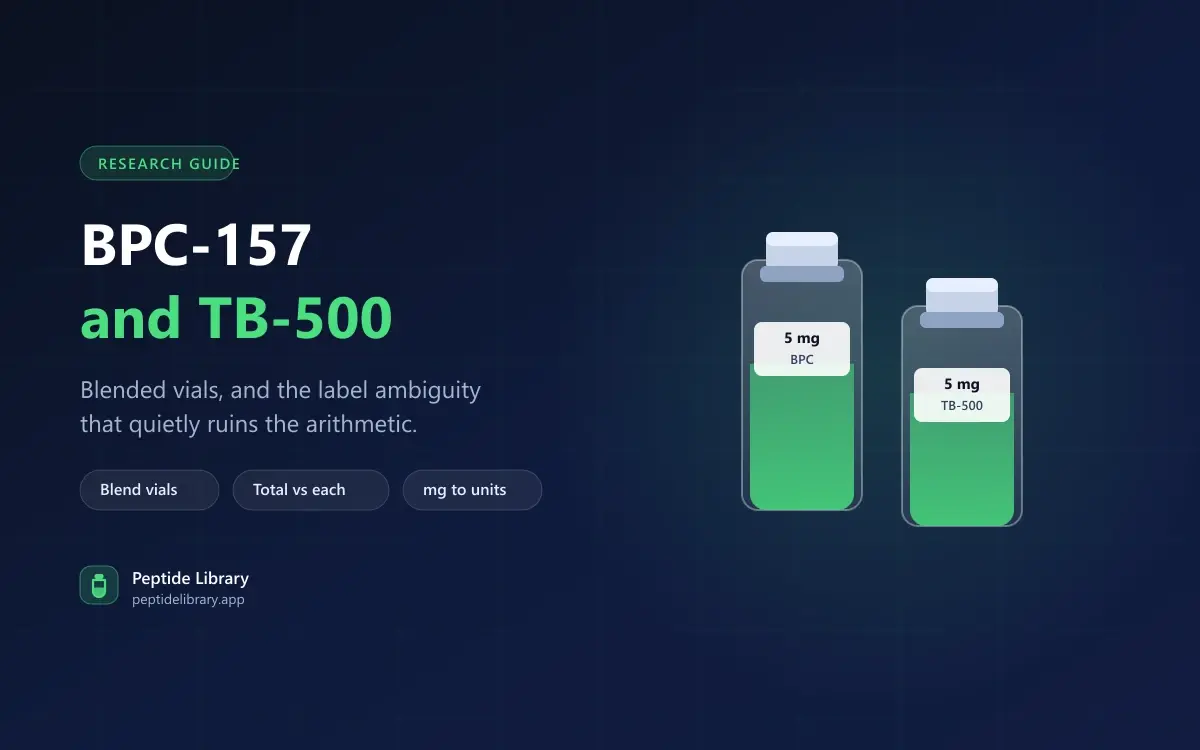
A vial labelled "BPC-157 / TB-500 10 mg" can mean 5 mg of each, or 10 mg of each. Those two readings differ by a factor of two, and nothing on most labels tells you which one you are holding.
That ambiguity — not the peptides themselves — is where blend arithmetic goes wrong. This covers what each compound is, why they are paired, and how to work out what a blended vial actually contains.
Neither is approved for human use. BPC-157 and TB-500 are research compounds, not medicines. They are sold for laboratory use only, and nothing here is dosing guidance.
For where the "Wolverine stack" name came from, why the composition varies between sellers, and what the personal accounts can and cannot show, see the Wolverine stack guide. This page is about the arithmetic and the two research literatures behind it.
What each one is
BPC-157 is a synthetic fifteen-amino-acid peptide derived from a sequence found in gastric juice. Rodent studies report effects on gut and connective tissue healing. See the BPC-157 dosage guide for what that literature does and does not establish.
TB-500 is a synthetic fragment of thymosin beta-4, a naturally occurring protein involved in actin regulation and cell migration. It is a fragment, not the full protein — a distinction vendors often blur.
They are paired because the preclinical rationales are complementary rather than overlapping: different proposed mechanisms, similar proposed outcomes. That is a hypothesis, not a demonstrated synergy — no controlled study has shown the combination outperforms either alone.
The two literatures are not alike
The pairing implies two comparable compounds. They are not comparable, and the difference is in the kind of evidence rather than the amount.
BPC-157 | TB-500 | |
|---|---|---|
Volume of literature | Large | Moderate |
Dominant study type | Rodent injury models | Rodent work, plus trials of the parent protein |
Independent replication | Limited — much from one research lineage | Broader, but mostly on thymosin beta-4 |
Human trials of this molecule | None completed | None completed |
Human trials of a related molecule | None | Yes — thymosin beta-4, modest results |
BPC-157's problem is provenance rather than quantity. The gut, tendon and ligament work is extensive and internally consistent (Sikiric 2011; Chang 2011), but a large share originates from a single research group, so the citation count overstates how independently corroborated it is.
TB-500's problem is identity. Thymosin beta-4 — the full protein — has a well-described role in actin sequestration and cell migration (Goldstein 2005) and reached randomised human trials, including a placebo-controlled phase 2 study in dry eye where results were modest (Sosne and Ousler 2015). TB-500 is a fragment of that protein. Trial results for the parent do not transfer to the fragment, and vendors describing "clinical trials of TB-500" are almost always describing thymosin beta-4.
Structured reviews of injectable peptides in sports medicine reach a consistent verdict on the pair: the mechanistic rationale is real, the human evidence supporting the marketed use is not, and both compounds are prohibited in tested sport (Villegas Meza 2026).
What neither literature establishes
That the combination does anything. No study has tested the two together, in any species.
A human dose for either. Circulating figures come from practice and vendor labelling.
That rodent tissue-repair results transfer. Accelerated healing in a rat Achilles model is a finding about rats.
Combinations built on this pair — including GLOW and KLOW, which add components on top of it — are catalogued with evidence grades in the peptide stacks directory.
The labelling problem
Blended vials are labelled in one of two conventions, and both are common:
Label reads | Reading A — total | Reading B — each |
|---|---|---|
"Blend 10 mg" | 5 mg BPC + 5 mg TB | 10 mg BPC + 10 mg TB |
Total peptide in vial | 10 mg | 20 mg |
At 2 mL, BPC concentration | 2.5 mg/mL | 5 mg/mL |
250 mcg BPC works out to | 10 units | 5 units |
Resolve this before you add water, not after. A vendor listing that says "10 mg blend" without a breakdown is incomplete — ask for the per-peptide masses, or find a listing that states them. Once the powder is dissolved there is no way to tell the two apart by looking.
Working out a blended vial
Treat each peptide as its own calculation sharing one diluent volume. For a vial containing 5 mg BPC-157 and 5 mg TB-500, reconstituted with 3 mL:
BPC-157: 5 mg ÷ 3 mL = 1.67 mg/mL, so 250 mcg is 0.15 mL — 15 units.
TB-500: 5 mg ÷ 3 mL = 1.67 mg/mL, so 2.5 mg is 1.5 mL — 150 units, more than one barrel.
The constraint: one draw delivers both in a fixed ratio. You cannot adjust one without adjusting the other.
That last point is the real trade-off of a blend, and it is rarely stated. Separate vials cost more and take more work, but they let each component vary independently. A blend fixes the ratio at whatever the vendor chose. The peptide calculator handles blend vials with per-component concentrations.
Why the scale mismatch makes this pair awkward
Most blend pairs are awkward. This one is worse than most, and the reason is arithmetic rather than pharmacology.
BPC-157 is discussed in micrograms; TB-500 is discussed in milligrams — roughly a tenfold difference in the amounts each is typically used at. A vial holding equal masses therefore cannot deliver a plausible amount of both in the same draw. Reaching a common TB-500 quantity means drawing several times the BPC-157 that would otherwise be used; sizing the draw for BPC-157 means a fraction of the TB-500.
There is no reconstitution volume that fixes this, because dilution scales both components together. It is a property of the fixed ratio, not of how much water is added — which is the strongest practical argument for separate vials for this particular pair.
Handling, stability and storage
Both are lyophilised powders with the same basic requirements: reconstitute gently down the vial wall rather than directly onto the powder, refrigerate once mixed, never freeze a reconstituted solution.
Neither has published stability data at research concentrations, so the operative limits are general ones. Peptides in solution degrade by hydrolysis, oxidation, deamidation and aggregation, and those processes are driven by temperature, light, pH and agitation rather than by anything visible (Manning 2010) — a clear solution is not evidence of an intact one. In practice the binding constraint is the shorter of peptide stability and the 28-day limit on bacteriostatic water. The bacteriostatic water guide and the storage guide cover both.
Frequently asked questions
How do you dose BPC-157 and TB-500 together?
There is no established human dose for either compound, so there is no answer to give — the figures circulating come from community practice rather than from human pharmacokinetic studies. What this guide covers is the arithmetic: how to work out what a given vial and water volume produce per unit drawn, which is a separate question from what quantity is appropriate.
Can they be mixed in one syringe?
In a pre-blended vial they already are. Combining two separately reconstituted vials in one syringe introduces an extra transfer and another chance to contaminate a stopper, for no benefit over two draws.
Is a blend cheaper than separate vials?
Usually per milligram, yes — but only if the label states per-peptide masses. A "10 mg blend" priced against two 10 mg vials is not the comparison it appears to be if it actually contains 5 mg of each. Compare on price per mg of each component.
Why is the ratio a problem for this pair specifically?
Because the two are used at scales about ten times apart — micrograms for BPC-157, milligrams for TB-500. A fixed ratio cannot suit both, and changing the water volume does not help because it dilutes both equally.
Does TB-500 need different handling from BPC-157?
Both are lyophilised powders with the same handling requirements: gentle reconstitution, refrigeration once mixed, no freezing.
Has the combination been studied?
No. Neither compound has completed a controlled human efficacy trial on its own, and no study of any kind has tested the two together.
Research and educational use only. Peptide Library is an independent research and comparison platform and does not sell peptides. Nothing here is medical advice, dosing guidance, or a recommendation to administer any substance to a person or an animal. Consult a licensed clinician for anything concerning human health.
Sources
- 1. Sikiric P, Seiwerth S, et al. Stable gastric pentadecapeptide BPC 157: novel therapy in gastrointestinal tract. Curr Pharm Des. 2011;17(16):1612-32. — Current Pharmaceutical Design (2011) Source PubMed
- 2. Chang CH, Tsai WC, et al. The promoting effect of pentadecapeptide BPC 157 on tendon healing involves tendon outgrowth, cell survival, and cell migration. J Appl Physiol. 2011;110(3):774-80. — Journal of Applied Physiology (2011) Source PubMed
- 3. Goldstein AL, Hannappel E, et al. Thymosin beta4: actin-sequestering protein moonlights to repair injured tissues. Trends Mol Med. 2005;11(9):421-9. — Trends in Molecular Medicine (2005) Source PubMed
- 4. Sosne G, Ousler GW. Thymosin beta 4 ophthalmic solution for dry eye: a randomized, placebo-controlled, Phase II clinical trial. Clin Ophthalmol. 2015;9:877-84. — Clinical Ophthalmology (2015) Source PubMed
- 5. Villegas Meza AD, Nocek M, et al. Injectable Peptides in Sports Medicine: A Structured Narrative Review of Evidence, Safety, and Antidoping Implications. JBJS Rev. 2026;14(5). — JBJS Reviews (2026) Source PubMed
- 6. Manning MC, Chou DK, et al. Stability of protein pharmaceuticals: an update. Pharm Res. 2010;27(4):544-75. — Pharmaceutical Research (2010) Source PubMed
Author
Peptide Library Editorial
Editorial content from Peptide Library. Research and educational use only. Not medical advice.
Related articles
Related peptides
Research smarter with Peptide Library.
Compare peptides, review vendor data, and use research calculators in one place.
Explore the LibraryResearch and educational use only. Not medical advice. Peptide Library does not sell peptides.