Peptide Guides
GLOW Peptide Blend: What Is Actually in the Vial
GLOW is GHK-Cu, BPC-157 and TB-500 in one vial, typically 70 mg. What each component is, what the research on each actually shows, why the ratio is lopsided, and how the reconstitution math works.
Peptide Library Editorial · January 2, 2026 · 9 min read
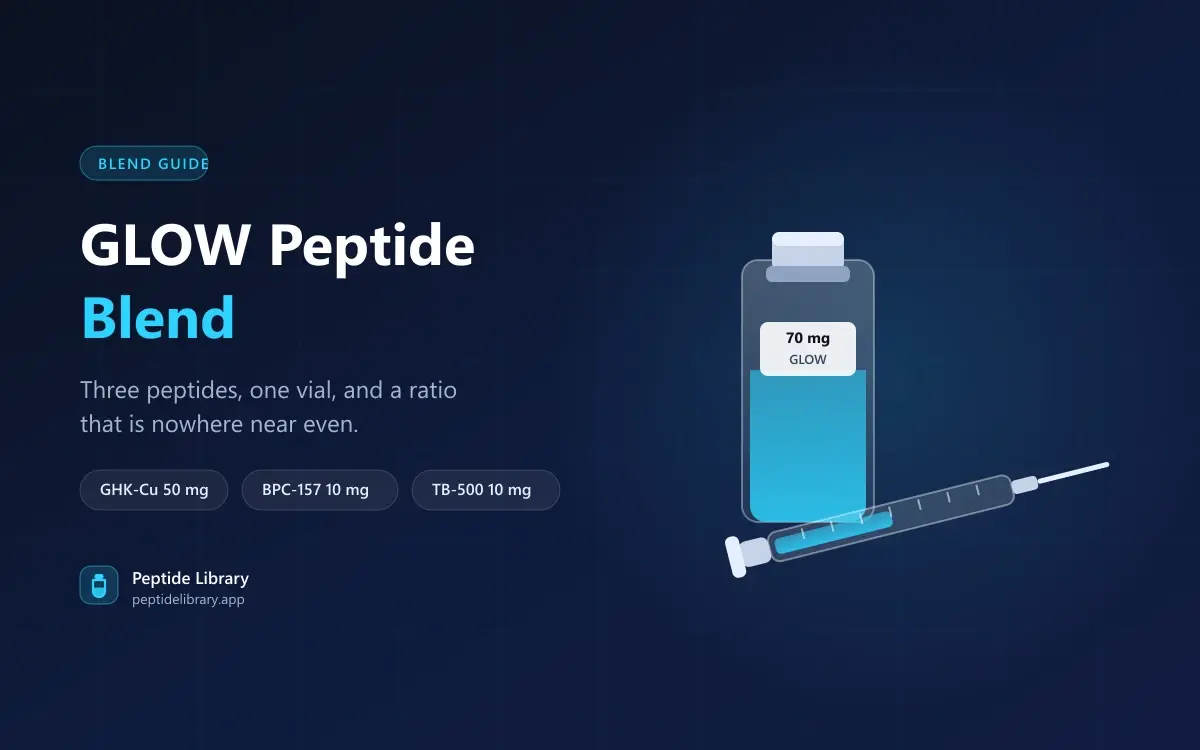
GLOW is a marketing name for a vial containing three separate peptides: GHK-Cu, BPC-157, and TB-500. The common configuration is 70 mg total — 50 mg GHK-Cu, 10 mg BPC-157, and 10 mg TB-500.
That ratio is the single most important thing about it, and it is the thing product pages tend to bury. Five sevenths of the vial is one component.
Not an approved product. None of the three components is an approved drug, and the blend as a whole has never been studied as a combination. It is sold for laboratory research only, and nothing here is dosing guidance.
The three components
Component | Typical mass | What it is | Studied mainly for |
|---|---|---|---|
GHK-Cu | 50 mg | Copper-bound tripeptide | Skin, collagen — largely topical evidence |
BPC-157 | 10 mg | 15-amino-acid peptide | Gut and connective tissue, in rodents |
TB-500 | 10 mg | Thymosin beta-4 fragment | Cell migration, actin regulation |
Each has its own profile and its own evidence problems. The GHK-Cu guide covers why its research is mostly topical rather than injectable, and the BPC-157 and TB-500 guide covers how those two behave together.
What each component has been researched for
This is the question the product pages answer least carefully, so it is worth separating what has actually been studied from what is claimed. The three components sit at very different points on the evidence scale, and the blend inherits the weakest of them rather than the strongest.
GHK-Cu has the most substantial human literature of the three, and it is the reason the blend is named for appearance. It is a naturally occurring copper-binding tripeptide first isolated from human plasma, where its concentration declines with age. It has been investigated for collagen synthesis, wound repair and skin remodelling, and reported in cell work to modulate a large number of genes (Pickart 2008; Pickart and Margolina 2018). The critical qualifier: the human evidence is topical and cosmetic — creams and serums measuring skin thickness, elasticity and appearance. None of it establishes what injected GHK-Cu does.
BPC-157 is a synthetic 15-amino-acid sequence derived from a protein found in gastric juice. Its literature is substantial in volume and almost entirely rodent-based, covering gut, tendon, ligament and muscle injury models, with angiogenesis and growth-factor receptor expression proposed as mechanisms (Sikiric 2011; Chang 2011). It has not completed a controlled human efficacy trial for any indication.
TB-500 is a synthetic fragment related to thymosin beta-4, a naturally occurring actin-sequestering protein involved in cell migration and wound closure (Goldstein 2005). The distinction that matters: the parent protein reached human trials — for dry eye and for venous ulcers — and results were modest or mixed rather than decisive (Sosne and Ousler 2015; Guarnera 2007). Those trials tested thymosin beta-4 itself, not the TB-500 fragment sold for research, and not by the route the blend uses.
What the evidence does not show
Three things, stated plainly, because the gap between them and the marketing is where most of the confusion lives:
Nothing has been studied about the combination. There is no trial, controlled or otherwise, of these three compounds used together in humans or animals. Every claim about GLOW is an extrapolation from the components.
Component evidence does not add up. Two of the three have no human efficacy data at all, and the third has human data only by a route the blend does not use. Combining three uncertain things does not produce a certain one.
No dosing has been established for any of them by injection. The figures circulating in research communities come from practice and vendor labelling, not from human pharmacokinetic studies.
The combinations discussed alongside GLOW, and what is known about each, are catalogued in the peptide stacks directory with an explicit evidence grade per entry.
Why the ratio is lopsided
The masses are not arbitrary. GHK-Cu is discussed at milligram scale while BPC-157 and TB-500 are discussed at microgram-to-low-milligram scale, so a blend intended to deliver a plausible amount of each ends up dominated by the GHK-Cu.
The consequence is the fixed-ratio problem that applies to every blend: one draw delivers all three in proportions the vendor chose. If you want more of one, you get more of all of them.
The GHK-Cu component drives everything. At 50 mg it is five times the mass of any other component. Dissolving it at a workable concentration means a lot of diluent, and a lot of diluent means a lot of solution to use inside the 28-day window. That constraint is the practical problem with these blends, and it is rarely mentioned on the product page.
The vial math
Treat it as three calculations sharing one diluent volume. For a 70 mg vial reconstituted with 5 mL:
Component | Mass | Concentration | 10 units delivers |
|---|---|---|---|
GHK-Cu | 50 mg | 10 mg/mL | 1 mg |
BPC-157 | 10 mg | 2 mg/mL | 200 mcg |
TB-500 | 10 mg | 2 mg/mL | 200 mcg |
So a single 10-unit draw is simultaneously 1 mg of GHK-Cu and 200 mcg each of BPC-157 and TB-500. Whether that combination is sensible is a question the blend format does not let you adjust. The peptide calculator handles per-component concentrations.
Will three peptides survive in one vial?
This question comes up constantly in research discussion and no published work settles it, which is itself worth knowing before treating a premixed vial as equivalent to three separate ones.
The concern is specific rather than general. GHK-Cu is not an inert companion: it is an acidic, copper-coordinated molecule, and transition metals such as copper are a recognised catalyst of oxidative degradation in peptide and protein formulations — one of the standard degradation pathways formulation scientists design around, alongside hydrolysis, deamidation and aggregation (Manning 2010). Whether BPC-157 and TB-500 remain intact alongside 50 mg of GHK-Cu across a multi-week storage period at working concentrations has not, as far as any published literature shows, been tested.
That is not a claim that premixed blends degrade. It is a statement that nobody has demonstrated they do not, and that the usual reassurance — the solution still looks fine — is not evidence, because oxidation and deamidation do not change a solution's appearance.
Separate vials are the way to answer this. Buying the components individually costs more and takes three reconstitutions, but it removes the compatibility question entirely, lets the ratio be varied, and makes it possible to attribute any observed effect to a specific compound.
Why the solution is blue
The blue-to-turquoise colour comes from the copper ion in GHK-Cu. Copper(II) complexes absorb in the red part of the spectrum and transmit blue, which is why copper compounds are characteristically blue or green. It is a property of the molecule, not a dye and not a contaminant.
Colour intensity tracks roughly with GHK-Cu concentration, so a more concentrated reconstitution looks deeper. What colour does not indicate is potency, purity, or that the vial contains what the label says. A blue solution tells you copper is present. It tells you nothing about the other components, the masses, or the quality of any of it — those come from a certificate of analysis, and the guide to reading a COA covers what to look for.
The case for and against blends
For: one vial, one reconstitution, one injection instead of three. Usually cheaper per milligram.
Against: the ratio is fixed, so you cannot vary components independently.
Against: if you react badly, you cannot tell which component caused it.
Against: the compatibility question above applies to every premixed vial and to none of the separate ones.
Against: the large diluent volume the GHK-Cu demands means much of the vial may expire before it is used. See the storage guide.
Reported effects and what is not known about safety
No component of GLOW has been through the safety evaluation an approved drug receives, so there is no adverse-event profile in the sense a medicine has one. What exists is scattered: rodent toxicology for some components, human tolerability data from the thymosin beta-4 trials, and the reports research communities generate about themselves, which are uncontrolled and subject to every reporting bias.
What is described most often is local: injection-site reactions, transient stinging, redness. GHK-Cu is the component most associated with that, which is consistent with an acidic copper-containing solution. Copper is also the component with a genuine theoretical ceiling — it is an essential trace element with an established upper intake level, and repeated administration of milligram quantities is not the same exposure as a topical serum.
The honest summary is that absence of reported harm here is weak evidence of safety, because nobody is systematically collecting the reports. That is a different statement from "it is dangerous", and it should not be read as either reassurance or alarm.
Storage
Storage is the same as any reconstituted vial: 2–8 °C, protected from light, never frozen, and bounded by the shorter of peptide stability and the 28-day limit on bacteriostatic water. The bacteriostatic water guide covers the detail.
Frequently asked questions
Is GLOW a single peptide?
No. It is a vendor name for a three-peptide mixture. There is no molecule called GLOW.
What is GLOW peptide used for?
In research contexts it is discussed for skin appearance and soft-tissue repair, on the basis that GHK-Cu has been investigated for collagen and skin remodelling while BPC-157 and TB-500 have been investigated for tissue repair in animal models. No use is approved, and the combination itself has not been studied for any purpose.
What does GLOW peptide do?
That depends on which claim is being examined. GHK-Cu has demonstrable effects on skin in topical human studies. BPC-157 and TB-500 have effects in rodent injury models. What the three do together, by injection, in humans, is unstudied — so any specific answer about the blend is an inference rather than a finding.
Why is GLOW blue?
Because of the copper in GHK-Cu. Copper(II) complexes appear blue. The colour is not a dye, and it does not indicate potency or purity.
Is GLOW safe?
There is no adequate safety data on the combination, and none of the components has completed the evaluation an approved drug undergoes. Local injection-site reactions are the most commonly described effect. Absence of documented harm is not the same as demonstrated safety when nobody is systematically collecting reports.
Do all vendors use the same ratio?
The 50/10/10 configuration is common but not universal, and some vials are labelled only with a total. Check the per-component masses before reconstituting — the arithmetic depends entirely on them.
How does GLOW differ from KLOW?
KLOW is the same three components plus KPV, typically 80 mg rather than 70 mg. See the KLOW guide.
Research and educational use only. Peptide Library is an independent research and comparison platform and does not sell peptides. Nothing here is medical advice, dosing guidance, or a recommendation to administer any substance to a person or an animal. Consult a licensed clinician for anything concerning human health.
Sources
- 1. Pickart L, Margolina A. Regenerative and Protective Actions of the GHK-Cu Peptide in the Light of the New Gene Data. Int J Mol Sci. 2018;19(7):1987. — International Journal of Molecular Sciences (2018) Source PubMed
- 2. Pickart L. The human tri-peptide GHK and tissue remodeling. J Biomater Sci Polym Ed. 2008;19(8):969-88. — Journal of Biomaterials Science, Polymer Edition (2008) Source PubMed
- 3. Sikiric P, Seiwerth S, et al. Stable gastric pentadecapeptide BPC 157: novel therapy in gastrointestinal tract. Curr Pharm Des. 2011;17(16):1612-32. — Current Pharmaceutical Design (2011) Source PubMed
- 4. Chang CH, Tsai WC, et al. The promoting effect of pentadecapeptide BPC 157 on tendon healing involves tendon outgrowth, cell survival, and cell migration. J Appl Physiol. 2011;110(3):774-80. — Journal of Applied Physiology (2011) Source PubMed
- 5. Goldstein AL, Hannappel E, et al. Thymosin beta4: actin-sequestering protein moonlights to repair injured tissues. Trends Mol Med. 2005;11(9):421-9. — Trends in Molecular Medicine (2005) Source PubMed
- 6. Sosne G, Ousler GW. Thymosin beta 4 ophthalmic solution for dry eye: a randomized, placebo-controlled, Phase II clinical trial. Clin Ophthalmol. 2015;9:877-84. — Clinical Ophthalmology (2015) Source PubMed
- 7. Guarnera G, De Rosa A, et al. Thymosin beta-4 and venous ulcers: clinical remarks on a European prospective, randomized study on safety, tolerability, and enhancement on healing. Ann N Y Acad Sci. 2007;1112:407-12. — Annals of the New York Academy of Sciences (2007) Source PubMed
- 8. Manning MC, Chou DK, et al. Stability of protein pharmaceuticals: an update. Pharm Res. 2010;27(4):544-75. — Pharmaceutical Research (2010) Source PubMed
Author
Peptide Library Editorial
Editorial content from Peptide Library. Research and educational use only. Not medical advice.
Related articles
Related peptides
Research smarter with Peptide Library.
Compare peptides, review vendor data, and use research calculators in one place.
Explore the LibraryResearch and educational use only. Not medical advice. Peptide Library does not sell peptides.