Peptide Research
What Is Retatrutide? The Triple Agonist, Explained
Retatrutide is the first triple agonist to reach late-stage obesity trials. Understanding it means understanding what a third receptor adds to an already effective pair.
Peptide Library Editorial · September 10, 2026 · 3 min read
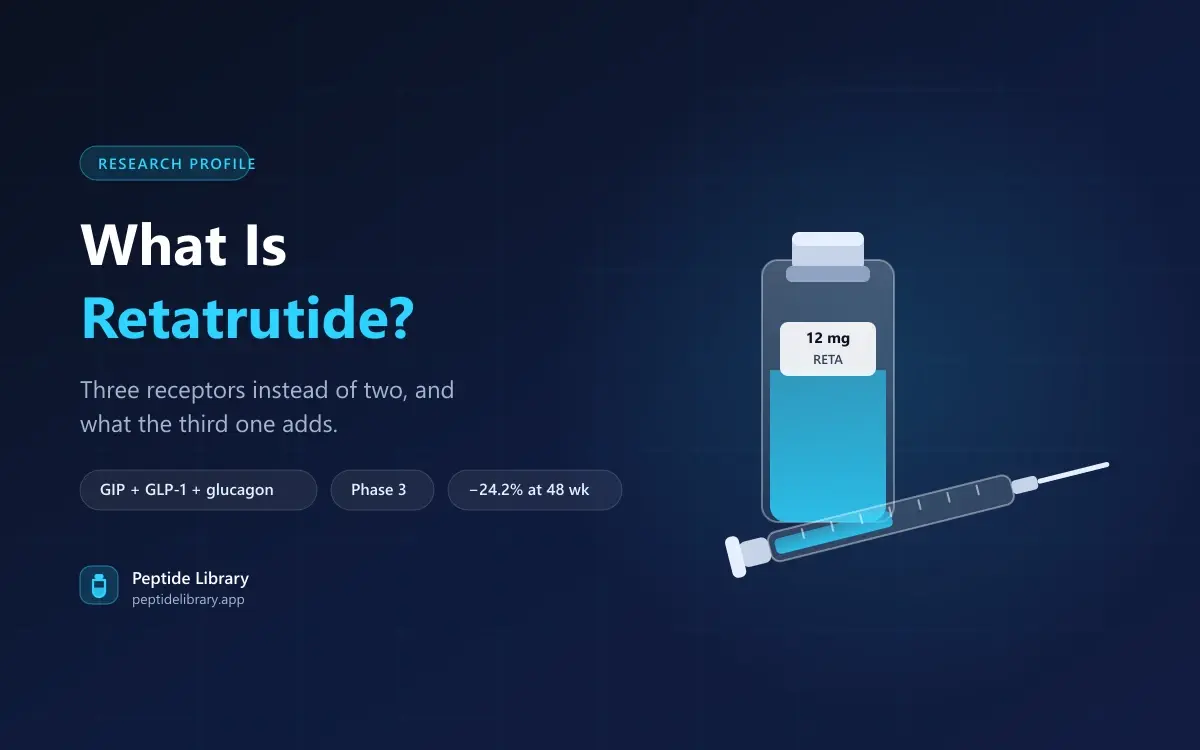
Retatrutide is an investigational peptide that activates three receptors at once: GIP, GLP-1, and glucagon. Semaglutide activates one. Tirzepatide activates two. Retatrutide adds the third.
That progression is the simplest way to understand where it sits, and why its phase 2 results attracted the attention they did.
Investigational, not approved. Retatrutide has no approved indication anywhere and no established dose. Everything here is published trial data reported for reference, not dosing guidance.
The three receptors
Receptor | What activating it does |
|---|---|
GLP-1 | Slows gastric emptying, reduces appetite, glucose-dependent insulin release |
GIP | Improves insulin sensitivity; may soften the nausea that limits GLP-1 activity |
Glucagon | Increases energy expenditure and acts on the liver |
The first two act largely on how much you take in. The third acts on how much you burn. Combining both sides of the equation in one molecule is the design idea.
What the phase 2 trial found
The NEJM phase 2 trial randomised 338 adults across placebo and four retatrutide arms, escalating gradually over 48 weeks.
Arm | Mean weight change at 48 weeks |
|---|---|
Placebo | −2.1% |
1 mg | −8.7% |
4 mg | −17.1% |
8 mg | −22.8% |
12 mg | −24.2% |
In the 12 mg arm, 100% of participants reached at least 5% reduction and 26% reached 30% or more. The dosage guide covers the escalation schedule those figures depend on.
The escalation is inseparable from the result. Participants did not start at 12 mg. The endpoint figure describes the top of a slow, monitored ramp — which is also why the tolerability data belong alongside it. See retatrutide side effects.
How it compares
The obvious comparison is with tirzepatide, and it cannot be made properly: no head-to-head trial exists, and the two figures people place side by side come from different trials, durations, populations and phases. See retatrutide vs tirzepatide for why that comparison does not hold.
Survodutide takes a different route to a similar idea — GLP-1 plus glucagon, without GIP — which makes the three of them a natural set to read together.
Where it stands
Phase 3 programmes are ongoing. That stage is where efficacy is confirmed at scale and where less common adverse effects surface — and it is where a meaningful share of candidate drugs fail or acquire restrictions.
Until it reports, anything sold as retatrutide is research material outside any regulated supply chain, with no assurance of identity, purity or content. The COA guide covers what can be verified about such material.
Frequently asked questions
Is retatrutide approved?
No. It is in phase 3 trials with no approval in any major jurisdiction.
What makes it different from tirzepatide?
The glucagon receptor. Tirzepatide targets GIP and GLP-1; retatrutide adds glucagon, which acts on energy expenditure and the liver.
Is there an established dose?
No. The trial arms are the only published figures, and they came with gradual escalation under clinical monitoring.
Research and educational use only. Peptide Library is an independent research and comparison platform and does not sell peptides. Nothing here is medical advice, dosing guidance, or a recommendation to administer any substance to a person or an animal. Consult a licensed clinician for anything concerning human health.
Sources
Author
Peptide Library Editorial
Editorial content from Peptide Library. Research and educational use only. Not medical advice.
Related articles
Related peptides
Related tools
Research smarter with Peptide Library.
Compare peptides, review vendor data, and use research calculators in one place.
Explore the LibraryResearch and educational use only. Not medical advice. Peptide Library does not sell peptides.