Peptide Research
Glutathione: The Tripeptide Your Cells Already Make
Glutathione is a genuine peptide — three amino acids — and one your body already makes in quantity. That is what makes supplementing it a more complicated question than it looks.
Peptide Library Editorial · September 17, 2026 · 3 min read
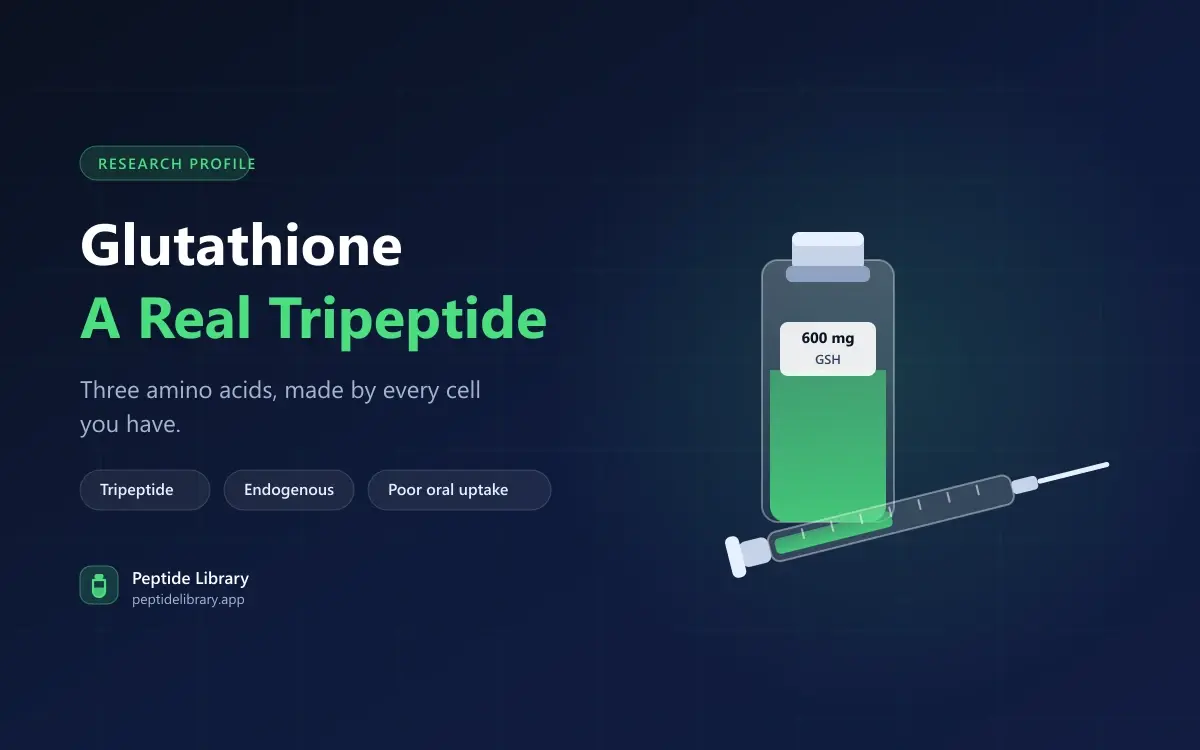
Glutathione is a tripeptide — glutamate, cysteine, glycine — and unlike several compounds sold in this space, it genuinely is a peptide. It is also one your cells synthesise continuously, in quantity, as the body’s principal intracellular antioxidant.
That last point is what makes supplementing it more complicated than it first appears.
Injectable glutathione is not an approved treatment in the US, EU, or UK. It appears in clinics and is sold as research material. Skin-lightening claims in particular have drawn regulatory warnings in several countries. Nothing here is dosing guidance.
What it does
Glutathione neutralises reactive oxygen species and is central to detoxification pathways in the liver, where it conjugates compounds for excretion. It cycles between reduced (GSH) and oxidised (GSSG) forms, and the ratio between them is used as a marker of oxidative stress.
Levels decline with age and are lower in a range of disease states, which is the observation driving supplementation interest — the same pattern seen with NAD+ and GHK-Cu.
Why oral glutathione is a problem
A tripeptide taken orally meets the same machinery as any other peptide: it is broken into its constituent amino acids. What reaches your cells is glutamate, cysteine and glycine — not glutathione.
That is why the supplement market splits three ways:
Oral glutathione. Largely digested; absorption of the intact tripeptide is limited.
Liposomal glutathione. Encapsulated to survive digestion, with variable evidence.
Precursors. N-acetylcysteine supplies the rate-limiting amino acid and lets the body make its own — mechanistically the most straightforward approach.
The precursor argument is the strong one. Cysteine availability limits synthesis. Supplying the building block your body is short of is a different and generally better-supported strategy than supplying the finished molecule and hoping it survives. See oral peptides.
What injection changes
Injection bypasses digestion, which is the case for it. What it does not settle is whether the intact tripeptide then enters cells efficiently — glutathione functions inside cells, and cellular uptake of the whole molecule is not a given.
That is the same unresolved question as with injectable NAD+: bypassing the gut is not the same as reaching the compartment where the molecule works.
The skin-lightening use
Much of the demand for injectable glutathione concerns skin lightening, via inhibition of melanin synthesis. This use has attracted specific regulatory attention in several countries, with warnings issued about unapproved intravenous products.
Two things are worth separating: whether the mechanism is plausible, and whether unregulated intravenous administration is a reasonable way to pursue it.
The vial math
Glutathione vials are large by peptide standards, because the amounts discussed are in hundreds of milligrams.
Vial | BAC water | Concentration | 100 mg | 200 mg |
|---|---|---|---|---|
600 mg | 3 mL | 200 mg/mL | 50 units | 100 units |
600 mg | 6 mL | 100 mg/mL | 100 units | Over one barrel |
1200 mg | 6 mL | 200 mg/mL | 50 units | 100 units |
As with NAD+, the volumes involved are far larger than a typical peptide vial, and much of a reconstituted vial may expire before use. The storage guide covers that constraint.
Storage
Storage is the same as any reconstituted vial: 2–8 °C, protected from light, never frozen, and bounded by the shorter of peptide stability and the 28-day limit on bacteriostatic water. The bacteriostatic water guide covers the detail.
Frequently asked questions
Is glutathione a peptide?
Yes — a genuine tripeptide, unlike several compounds sold alongside it that are small molecules.
Is oral glutathione useless?
Intact absorption is limited. Precursors such as N-acetylcysteine are the more mechanistically direct route to raising synthesis.
Does it lighten skin?
The proposed mechanism is inhibition of melanin synthesis. Unapproved intravenous products for this purpose have drawn regulatory warnings in several countries.
Research and educational use only. Peptide Library is an independent research and comparison platform and does not sell peptides. Nothing here is medical advice, dosing guidance, or a recommendation to administer any substance to a person or an animal. Consult a licensed clinician for anything concerning human health.
Sources
- 1. Glutathione Biology in Neurodegenerative and Metabolic Diseases: Molecular Mechanisms, Pathophysiological Roles, and Therapeutic Perspectives — International Journal of Molecular Sciences (2026) Source PubMed
- 2. Efficacy and Safety of Glutathione Supplementation in Type 2 Diabetes & Diabetes Complications — Nutrients (2026) Source PubMed
Author
Peptide Library Editorial
Editorial content from Peptide Library. Research and educational use only. Not medical advice.
Related articles
Related peptides
Related tools
Research smarter with Peptide Library.
Compare peptides, review vendor data, and use research calculators in one place.
Explore the LibraryResearch and educational use only. Not medical advice. Peptide Library does not sell peptides.