Peptide Research
LL-37: The Body’s Own Antimicrobial Peptide
LL-37 is not a foreign compound — the body makes it as part of innate immunity. That is what makes it interesting, and also why more of it is not straightforwardly better.
Peptide Library Editorial · July 3, 2026 · 3 min read
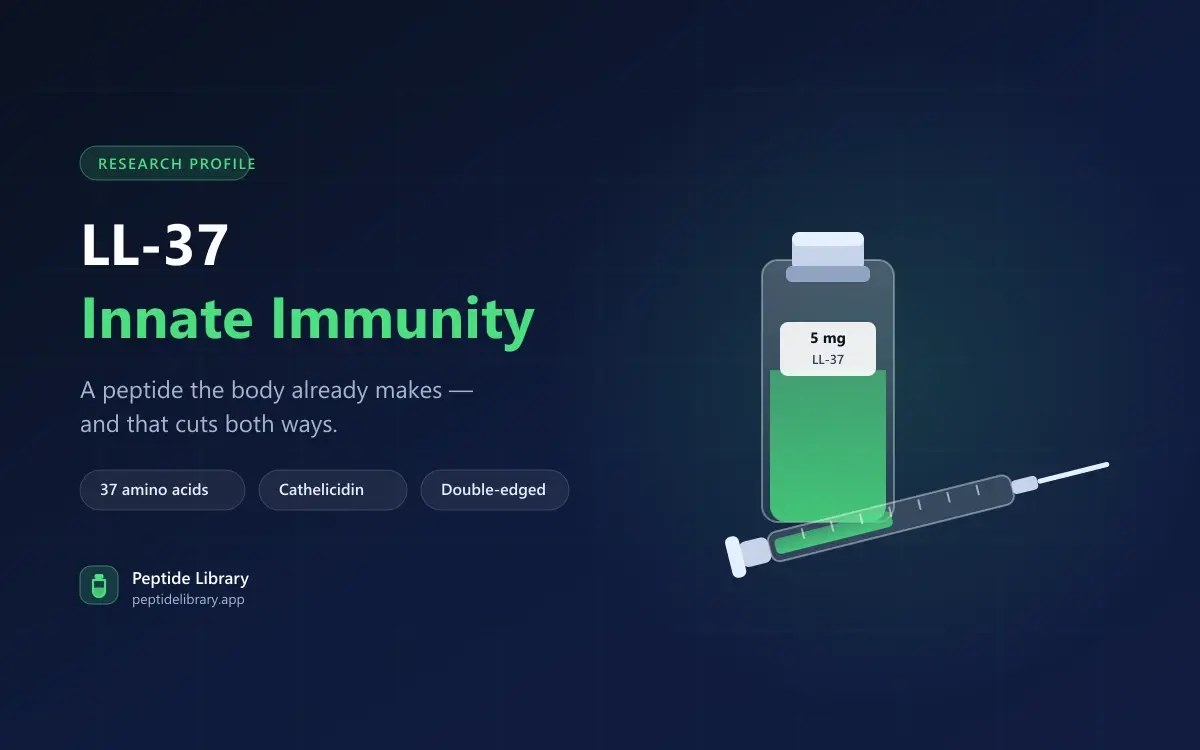
LL-37 is a 37-amino-acid peptide your body produces as part of innate immunity. It is the only human cathelicidin — released by neutrophils and epithelial cells, and one of the first-line defences against microbes.
Being endogenous is what makes it interesting as a therapeutic candidate. It is also why "more of it" is not a straightforwardly good idea.
Not an approved drug. LL-37 has no approved human indication in the US, EU, or UK and no established human dose. It is sold for laboratory research only, and nothing here is dosing guidance.
What it does
LL-37 is amphipathic — one face attracts water, the other repels it — which lets it insert into and disrupt bacterial membranes directly. That is a physical mechanism rather than a biochemical one, and it is why resistance to it develops less readily than to conventional antibiotics.
It also does more than kill microbes:
Immune signalling. Recruits immune cells and modulates inflammatory response.
Wound healing. Involved in re-epithelialisation and angiogenesis, which drives much of the therapeutic interest.
Biofilm disruption. Reported activity against bacterial biofilms, which resist conventional antibiotics.
Why it is double-edged
The same properties that make LL-37 useful make it a problem in excess. It is implicated in inflammatory conditions where its activity contributes to disease rather than resolving it — psoriasis and rosacea are the most cited examples, where elevated cathelicidin activity is part of the pathology rather than the defence.
This is the crucial asymmetry. A molecule the body regulates carefully is being regulated for a reason. LL-37 is not simply a good thing present in insufficient quantity — its level is controlled because both too little and too much cause problems.
Membrane disruption is also not perfectly selective. At sufficient concentration, the mechanism that lyses bacterial membranes acts on host cells too.
Where development has gone
LL-37 and derived peptides have been investigated clinically, most substantially for wound healing — hard-to-heal ulcers, where both the antimicrobial and the repair-promoting properties are relevant at once.
The delivery route is central. Topical application to a wound puts the peptide where both mechanisms are wanted; systemic injection distributes an immunomodulatory, membrane-active peptide everywhere. Most of the clinical work is topical, and that is not incidental.
It shares that pattern with GHK-Cu, where the evidence is likewise concentrated on topical use while vials are sold for injection.
The vial math
LL-37 is supplied lyophilised, commonly in 5 mg vials, with figures discussed in micrograms to low milligrams.
Vial | BAC water | Concentration | 100 mcg | 250 mcg | 500 mcg |
|---|---|---|---|---|---|
5 mg | 2 mL | 2.5 mg/mL | 4 units | 10 units | 20 units |
5 mg | 3 mL | 1.67 mg/mL | 6 units | 15 units | 30 units |
5 mg | 5 mL | 1 mg/mL | 10 units | 25 units | 50 units |
The peptide calculator converts any vial and target into units.
Storage
Storage is the same as any reconstituted vial: 2–8 °C, protected from light, never frozen, and bounded by the shorter of peptide stability and the 28-day limit on bacteriostatic water. The bacteriostatic water guide covers the detail.
Frequently asked questions
Is LL-37 an antibiotic?
It is an antimicrobial peptide with a membrane-disruption mechanism, which differs from how conventional antibiotics work. That mechanism is why resistance develops less readily.
If the body makes it, is it safe?
Endogenous does not mean safe at any level. LL-37 is implicated in inflammatory skin conditions where excess activity is part of the problem.
Why is most research topical?
Because wound healing puts both the antimicrobial and repair properties exactly where they are wanted. Systemic delivery distributes a membrane-active immunomodulator throughout the body instead.
Research and educational use only. Peptide Library is an independent research and comparison platform and does not sell peptides. Nothing here is medical advice, dosing guidance, or a recommendation to administer any substance to a person or an animal. Consult a licensed clinician for anything concerning human health.
Sources
Author
Peptide Library Editorial
Editorial content from Peptide Library. Research and educational use only. Not medical advice.
Related articles
Related tools
Research smarter with Peptide Library.
Compare peptides, review vendor data, and use research calculators in one place.
Explore the LibraryResearch and educational use only. Not medical advice. Peptide Library does not sell peptides.