Peptide Calculators
Insulin Syringe Units to mL: 1 mL Is 100 Units, and Why That Matters
The numbers on an insulin syringe measure volume, not drug. On a U-100 barrel 1 mL is 100 units — which means the same 10-unit mark can be two very different doses depending on how the vial was mixed.
Peptide Library Editorial · May 19, 2026 · 3 min read
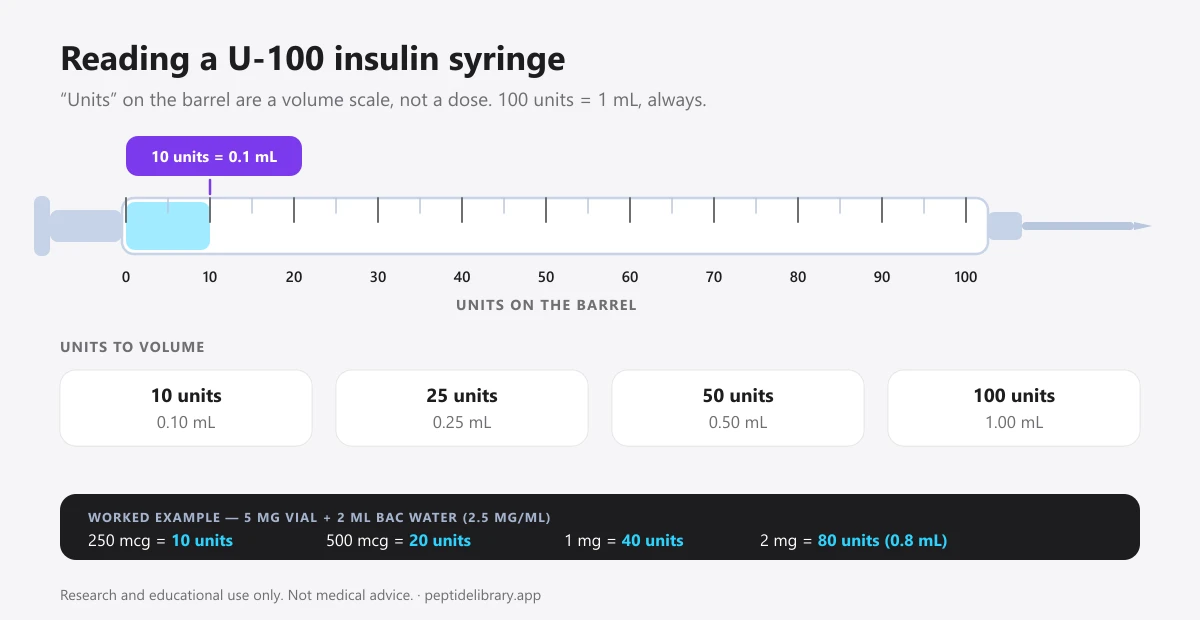
On a U-100 insulin syringe, 100 units equals 1 mL. Always. Ten units is 0.1 mL, twenty-five units is 0.25 mL, fifty units is 0.5 mL. The scale is volume, and it never changes.
What changes is how much peptide sits in that volume — and that is set entirely by how the vial was reconstituted. This is the single most common source of confusion in peptide measurement.
The conversion chart
Units | Millilitres | Fraction of barrel |
|---|---|---|
5 units | 0.05 mL | 1/20 |
10 units | 0.10 mL | 1/10 |
15 units | 0.15 mL | — |
20 units | 0.20 mL | 1/5 |
25 units | 0.25 mL | 1/4 |
30 units | 0.30 mL | — |
40 units | 0.40 mL | 2/5 |
50 units | 0.50 mL | 1/2 |
75 units | 0.75 mL | 3/4 |
100 units | 1.00 mL | Full |
Why "units" never tells you the dose
A unit is a volume mark. It says nothing about concentration, and concentration is what turns volume into an amount of peptide.
Take one 5 mg vial and reconstitute it two different ways:
Water added | Concentration | 10 units contains |
|---|---|---|
1 mL | 5 mg/mL | 500 mcg |
2 mL | 2.5 mg/mL | 250 mcg |
5 mL | 1 mg/mL | 100 mcg |
Same vial, same syringe, same 10-unit mark — five times the difference in peptide. This is why "take 10 units" is a meaningless instruction unless the concentration is stated alongside it.
The full conversion, in order
Concentration: mg in the vial ÷ mL of bacteriostatic water = mg/mL.
Match your units: multiply mg/mL by 1,000 to get mcg/mL if your target dose is in micrograms.
Volume: target dose ÷ concentration = mL.
Units: mL × 100 = units on a U-100 barrel.
Worked through: a 5 mg vial with 2 mL added is 2.5 mg/mL, or 2,500 mcg/mL. A 250 mcg target is 250 ÷ 2,500 = 0.1 mL, which is 10 units. The reconstitution calculator runs this for any combination.
Reading the barrel accurately
Read at the plunger tip, the flat front edge of the rubber stopper — not the raised rim behind it.
Read at eye level. Looking down at an angle shifts the apparent position by a unit or more.
Clear the air first. A bubble occupies volume, so the barrel reads correctly while the delivered amount is short.
Match the barrel to the draw. A 0.3 mL (30-unit) syringe has marks spaced further apart than a 1 mL barrel, so small volumes are measured more precisely on the smaller syringe.
U-100 versus U-40
U-40 syringes exist, mostly in veterinary use, and are calibrated so 40 units equals 1 mL. On a U-40 barrel 10 units is 0.25 mL, not 0.1 mL — two and a half times the volume. Mixing up the two is a serious error. Check the barrel is marked U-100 before using any chart on this page.
Frequently asked questions
How many units is 0.5 mL?
50 units on a U-100 syringe.
How many units is 2.5 mg?
Unanswerable without the concentration. At 5 mg/mL it is 50 units; at 2.5 mg/mL it is 100 units — a full barrel. Milligrams only become units once you know how the vial was mixed.
What is the smallest amount worth measuring?
Below about 5 units, small errors become large percentages. If a dose lands there, reconstitute with more water so the same amount reads as a larger, more forgiving number.
Research and educational use only. Peptide Library is an independent research and comparison platform and does not sell peptides. Nothing here is medical advice, dosing guidance, or a recommendation to administer any substance to a person or an animal. Consult a licensed clinician for anything concerning human health.
Sources
- 1. Bacteriostatic Water for Injection, USP — prescribing information — Hospira, Inc. / DailyMed, U.S. National Library of Medicine Source
Author
Peptide Library Editorial
Editorial content from Peptide Library. Research and educational use only. Not medical advice.
Related articles
Related tools
Research smarter with Peptide Library.
Compare peptides, review vendor data, and use research calculators in one place.
Explore the LibraryResearch and educational use only. Not medical advice. Peptide Library does not sell peptides.