Peptide Research
Cerebrolysin: A Brain Extract, Not a Defined Molecule
Cerebrolysin is not one molecule. It is a preparation of peptide fragments from porcine brain tissue — which makes standardisation, and therefore evaluation, genuinely difficult.
Peptide Library Editorial · May 12, 2026 · 3 min read
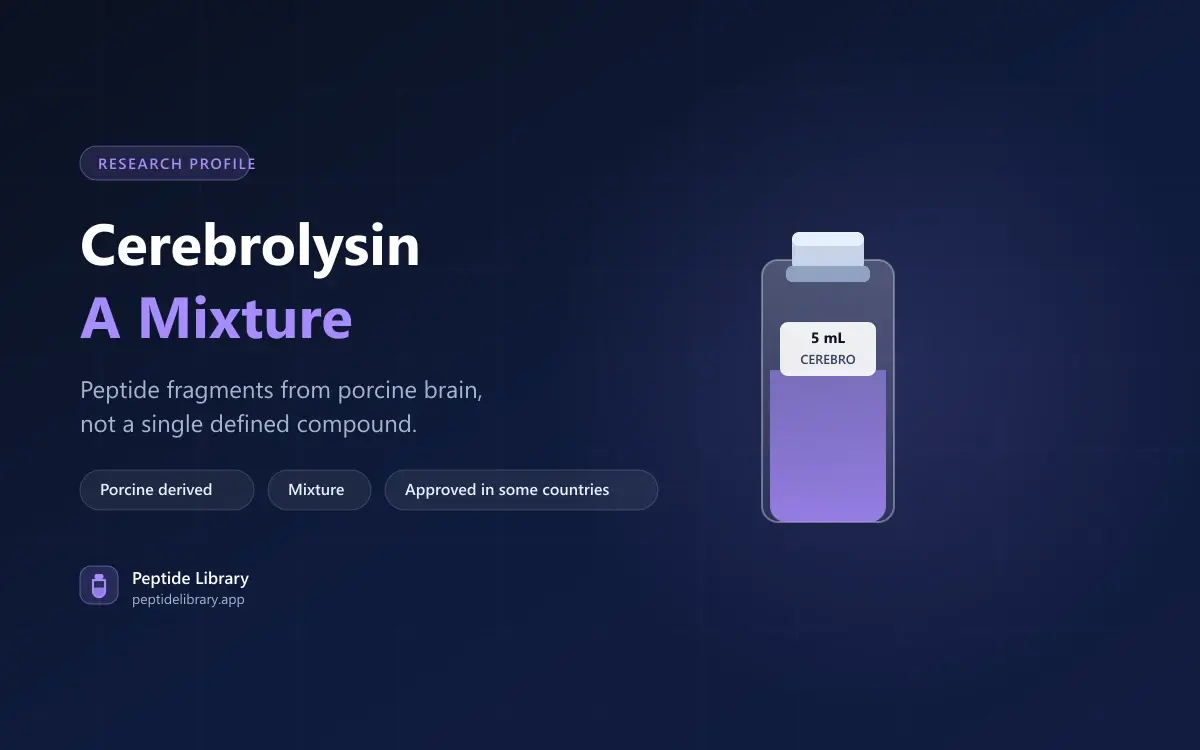
Cerebrolysin is not a single compound. It is a preparation of low-molecular-weight peptides and amino acids produced by enzymatic breakdown of purified porcine brain protein — a mixture, supplied as a solution rather than a lyophilised powder.
That distinguishes it from everything else on this site, and it is the fact that shapes how its evidence should be read.
Approved in some countries, not in the US, EU, or UK. Cerebrolysin has approvals in a number of jurisdictions, mainly for stroke and dementia indications. It is not approved in the US, EU, or UK, and material bought outside a regulated channel carries the usual absence of any quality guarantee.
Why "a mixture" matters
For a defined molecule, purity has a clear meaning: how much of the sample is the target compound, verifiable by HPLC and mass spectrometry. The COA guide sets out how that works.
For a biological extract, that framework does not apply cleanly:
There is no single target peak to integrate against — the product is a distribution of fragments.
Batch consistency depends on process control rather than on synthesising one molecule correctly.
"Purity 99%" is close to meaningless for a mixture, yet it appears on listings anyway.
The source is animal tissue, which introduces considerations synthetic peptides do not have.
If a vendor offers a certificate of analysis for cerebrolysin showing a single-peak HPLC purity figure, that is a sign the certificate was not produced for this product. A mixture cannot present as one peak.
What the clinical evidence covers
Cerebrolysin has a substantial trial literature, concentrated on acute ischaemic stroke, traumatic brain injury, and vascular dementia. It is used adjunctively in some countries — alongside standard care such as thrombectomy rather than instead of it.
The literature is genuinely mixed. Some trials and meta-analyses report benefit on functional outcome scales; others do not, and methodological criticism has been raised about parts of the evidence base. It is neither dismissible nor established.
Route and presentation
Cerebrolysin is supplied as a ready-made solution in ampoules, typically administered intravenously or intramuscularly in clinical use — often as an infusion rather than a simple injection.
That means none of the reconstitution arithmetic applies: there is no powder, no diluent choice, and no concentration to calculate. It also means the subcutaneous self-administration described in non-clinical settings differs from how it was studied.
Frequently asked questions
Is cerebrolysin a peptide?
It is a mixture containing peptides, rather than a peptide. That distinction matters for how purity, dosing, and batch consistency can be assessed at all.
Why is it not approved in the US?
It has not been through the FDA approval process. Approval elsewhere reflects different regulatory frameworks and evidence standards, as with thymosin alpha-1.
Can its purity be verified?
Not in the way a synthetic peptide’s can. For a biological extract the relevant assurance is manufacturing process control, which a buyer outside the regulated channel has no way to inspect.
Research and educational use only. Peptide Library is an independent research and comparison platform and does not sell peptides. Nothing here is medical advice, dosing guidance, or a recommendation to administer any substance to a person or an animal. Consult a licensed clinician for anything concerning human health.
Sources
Author
Peptide Library Editorial
Editorial content from Peptide Library. Research and educational use only. Not medical advice.
Related articles
Related peptides
Related tools
Research smarter with Peptide Library.
Compare peptides, review vendor data, and use research calculators in one place.
Explore the LibraryResearch and educational use only. Not medical advice. Peptide Library does not sell peptides.