Peptide Research
IGF-1 LR3: A Modified Growth Factor With a Long Tail
IGF-1 LR3 is engineered to slip past the binding proteins that normally control IGF-1. That single modification extends its half-life enormously — and removes a regulatory system that exists for a reason.
Peptide Library Editorial · February 27, 2026 · 3 min read
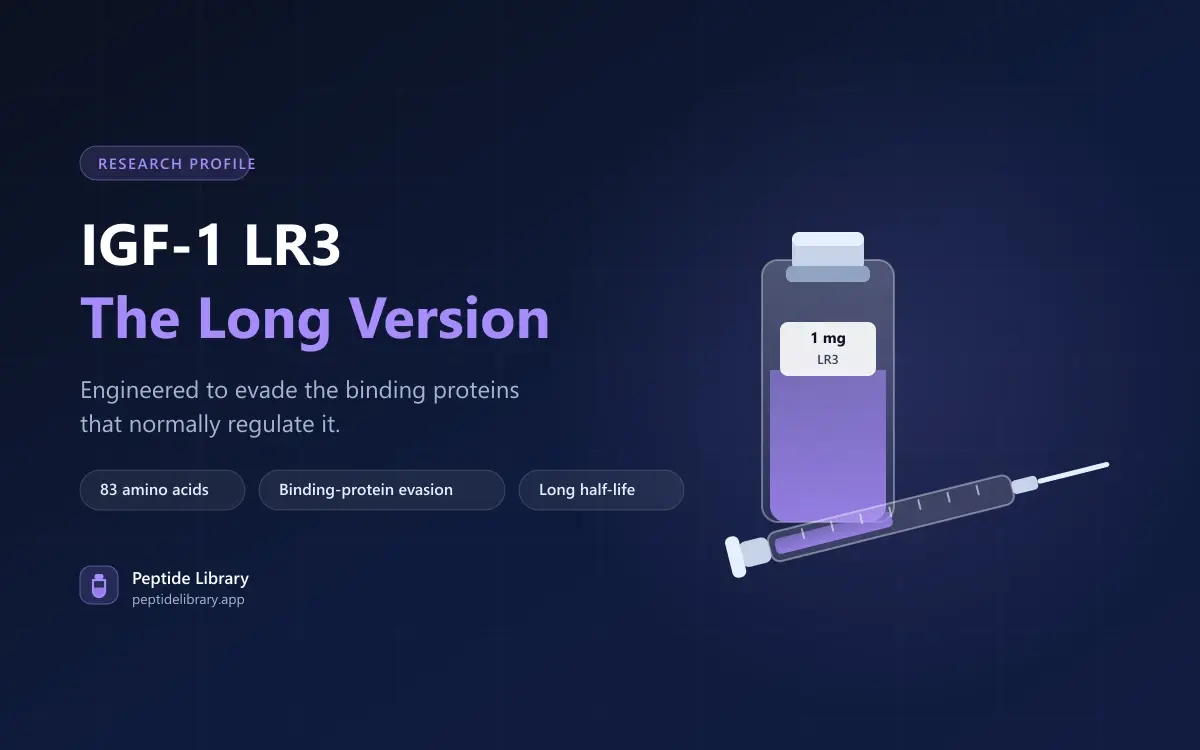
IGF-1 LR3 is insulin-like growth factor 1, modified in two ways: a substitution at position 3 and a 13-amino-acid extension at the N-terminus. Both changes serve one purpose — evading the binding proteins that normally control how much free IGF-1 is available.
The result is a molecule with a far longer half-life than native IGF-1. Whether that is an advantage depends on what you think those binding proteins are for.
Not an approved drug. IGF-1 LR3 has no approved human indication in the US, EU, or UK and no established human dose. It is sold for laboratory research only, and nothing here is dosing guidance.
What the modification does
In the body, the great majority of IGF-1 circulates bound to IGF binding proteins, principally IGFBP-3. Bound IGF-1 is inactive; only the small free fraction signals. That binding system is how the body regulates a potent growth signal.
LR3 is designed to bind those proteins poorly. Native IGF-1 has a half-life measured in minutes when free; LR3 persists far longer because it is not being sequestered.
The regulation is the safety mechanism. Binding proteins are not an inconvenience the modification cleverly solves — they are how a growth-promoting signal is kept in check. A version engineered to escape them removes that control by design, which is the central consideration with this compound and not a footnote.
IGF-1 is downstream of growth hormone
Growth hormone acts largely by prompting the liver to produce IGF-1, which mediates much of GH’s anabolic effect. That relationship explains where LR3 sits relative to everything else in this category.
Approach | Acts | Regulation retained |
|---|---|---|
GHRH analogues (sermorelin, tesamorelin) | Upstream — prompts GH release | Full — pituitary sets the ceiling |
GHRPs (ipamorelin, hexarelin) | Upstream — prompts GH release | Full — pituitary sets the ceiling |
Growth hormone | Direct hormone | Partial — feedback still operates |
IGF-1 LR3 | Downstream, binding-evasive | Minimal by design |
The sermorelin and ipamorelin guides cover the secretagogue end, where the body’s own limits still apply. LR3 is the opposite end of that spectrum.
Why the potency cuts both ways
IGF-1 signalling drives cell growth and proliferation, and it also has insulin-like activity — the name is not decorative. Two consequences follow directly:
Hypoglycaemia. Cross-reactivity with insulin receptors means blood glucose effects are a recognised concern with IGF-1 analogues.
Proliferative signalling. Growth signals act on whatever tissue is present. The IGF-1 axis is extensively studied in oncology for that reason, which is a consideration rather than a demonstrated harm from any particular product.
The vial math
IGF-1 LR3 is supplied lyophilised in small vials — 1 mg is common — with figures discussed in micrograms.
Vial | BAC water | Concentration | 20 mcg | 50 mcg | 100 mcg |
|---|---|---|---|---|---|
1 mg | 1 mL | 1 mg/mL | 2 units | 5 units | 10 units |
1 mg | 2 mL | 0.5 mg/mL | 4 units | 10 units | 20 units |
1 mg | 5 mL | 0.2 mg/mL | 10 units | 25 units | 50 units |
The 2-unit entry is not measurable with any accuracy. For microgram targets this small, generous dilution is the only way to get a readable number — see the insulin syringe guide. Note also that some sources specify acetic acid rather than bacteriostatic water for IGF-1 analogues; follow what the supplier states.
Storage
Storage is the same as any reconstituted vial: 2–8 °C, protected from light, never frozen, and bounded by the shorter of peptide stability and the 28-day limit on bacteriostatic water. The bacteriostatic water guide covers the detail.
Frequently asked questions
What does LR3 stand for?
Long R3 — the N-terminal extension ("long") plus an arginine substitution at position 3.
Is it the same as growth hormone?
No. GH acts on the pituitary-liver axis and prompts IGF-1 production; LR3 is a modified version of that downstream product, applied directly and engineered to evade regulation.
Why is the half-life quoted so inconsistently?
Because sources differ on whether they are describing native IGF-1, LR3, or the bound versus free fraction. Those are three different numbers, and they are frequently conflated.
Research and educational use only. Peptide Library is an independent research and comparison platform and does not sell peptides. Nothing here is medical advice, dosing guidance, or a recommendation to administer any substance to a person or an animal. Consult a licensed clinician for anything concerning human health.
Sources
Author
Peptide Library Editorial
Editorial content from Peptide Library. Research and educational use only. Not medical advice.
Related articles
Related peptides
Related tools
Research smarter with Peptide Library.
Compare peptides, review vendor data, and use research calculators in one place.
Explore the LibraryResearch and educational use only. Not medical advice. Peptide Library does not sell peptides.