Peptide Research
Gonadorelin: GnRH Itself, and Why the Schedule Decides the Effect
Gonadorelin is one of the few compounds where the administration schedule does not merely change the size of the effect — it reverses its direction entirely.
Peptide Library Editorial · July 21, 2026 · 3 min read
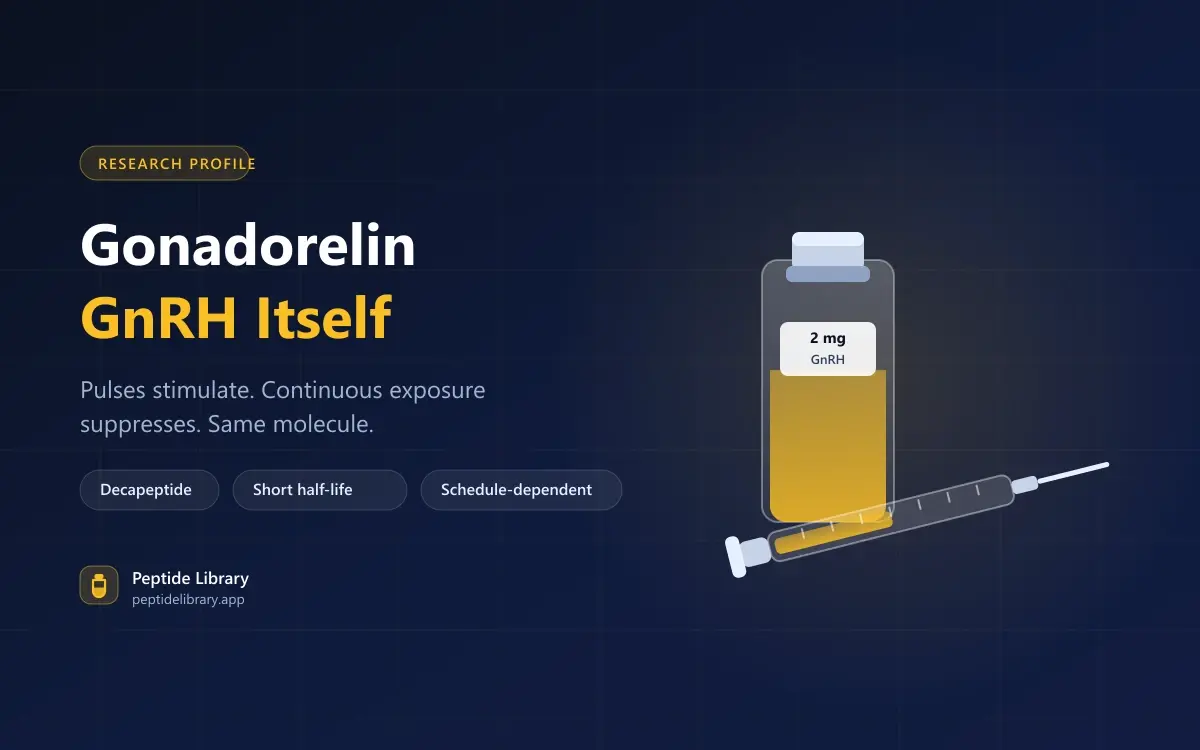
Gonadorelin is synthetic gonadotropin-releasing hormone — the same ten amino acids the hypothalamus releases. It acts on the pituitary to prompt LH and FSH release.
What makes it worth understanding is that the administration schedule does not just change how much effect you get. It changes the direction of the effect.
Prescription and research contexts differ. Gonadorelin has had approved diagnostic uses, and GnRH analogues are established medicines. Material sold as research-grade sits outside that entirely, and nothing here is dosing guidance.
Pulses stimulate, continuous exposure suppresses
The hypothalamus releases GnRH in pulses roughly every 60 to 120 minutes. The pituitary is built to respond to that rhythm, and sustained exposure causes its receptors to downregulate.
Administration | Effect on the axis | Used clinically for |
|---|---|---|
Pulsatile | Stimulates LH and FSH release | Inducing ovulation, fertility work |
Continuous / long-acting | Downregulates receptors, suppresses | Prostate cancer, endometriosis, puberty suppression |
This is why long-acting GnRH agonists suppress rather than stimulate. It is not a paradox or a side effect — it is receptor desensitisation used deliberately. The same principle appears with hexarelin in the growth hormone axis, where it is an unwanted complication instead of the therapeutic goal.
Where it sits relative to kisspeptin
The reproductive cascade runs kisspeptin → GnRH → LH/FSH → gonadal hormones. Gonadorelin is the second step; kisspeptin is the first.
That difference matters. Acting at the pituitary bypasses hypothalamic regulation; acting upstream at the GnRH neuron keeps it. Neither is simply better, but they are not interchangeable despite both being described as fertility-axis peptides.
The half-life problem
Native GnRH has a half-life of only a few minutes, and gonadorelin inherits it. That short duration is exactly what makes pulsatile stimulation possible — but it also means a single subcutaneous injection produces a brief spike, not a sustained signal.
Reproducing genuine pulsatility is the reason clinical protocols have used programmable infusion pumps rather than periodic injections. Approximating that with occasional injections is not the same intervention.
The vial math
Gonadorelin is supplied lyophilised, commonly in 2 mg or 10 mg vials, with figures discussed in micrograms.
Vial | BAC water | Concentration | 100 mcg | 200 mcg | 500 mcg |
|---|---|---|---|---|---|
2 mg | 2 mL | 1 mg/mL | 10 units | 20 units | 50 units |
2 mg | 1 mL | 2 mg/mL | 5 units | 10 units | 25 units |
10 mg | 5 mL | 2 mg/mL | 5 units | 10 units | 25 units |
The peptide calculator converts any vial and target into units.
Storage
Storage is the same as any reconstituted vial: 2–8 °C, protected from light, never frozen, and bounded by the shorter of peptide stability and the 28-day limit on bacteriostatic water. The bacteriostatic water guide covers the detail.
Frequently asked questions
Is gonadorelin the same as hCG?
No. Gonadorelin acts on the pituitary to prompt LH release; hCG mimics LH directly at the gonads. Different levels of the same axis, and not substitutes.
Why do GnRH drugs suppress testosterone?
Because long-acting formulations produce continuous rather than pulsatile exposure, which downregulates pituitary receptors. That suppression is the therapeutic goal in those medicines.
Does the injection schedule really matter that much?
For this compound more than almost any other. Frequency determines whether you stimulate or suppress the axis — the same molecule, opposite outcomes.
Research and educational use only. Peptide Library is an independent research and comparison platform and does not sell peptides. Nothing here is medical advice, dosing guidance, or a recommendation to administer any substance to a person or an animal. Consult a licensed clinician for anything concerning human health.
Sources
Author
Peptide Library Editorial
Editorial content from Peptide Library. Research and educational use only. Not medical advice.
Related articles
Related peptides
Related tools
Research smarter with Peptide Library.
Compare peptides, review vendor data, and use research calculators in one place.
Explore the LibraryResearch and educational use only. Not medical advice. Peptide Library does not sell peptides.