Peptide Research
Tesofensine: A Failed Parkinson’s Drug That Became a Weight-Loss Compound
Tesofensine is sold alongside peptides but is not one — it is a small-molecule brain drug. Its weight-loss effect was discovered by accident, when it failed at the thing it was designed for.
Peptide Library Editorial · January 9, 2026 · 3 min read
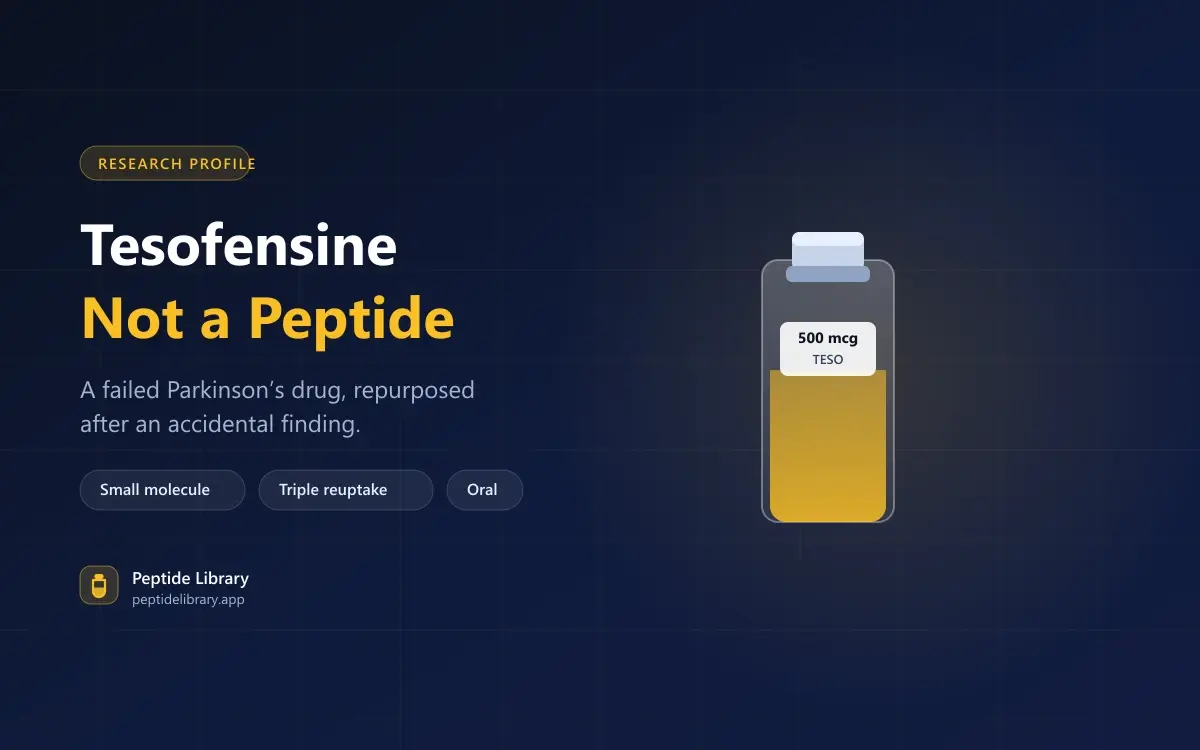
Tesofensine is not a peptide. It is a small molecule — a triple monoamine reuptake inhibitor, blocking the reuptake of noradrenaline, dopamine, and serotonin. It contains no amino acid chain and shares nothing structurally with anything else on this site.
It is sold by peptide vendors and discussed in the same communities, which is how it ends up in these conversations. Its actual history is more interesting than that framing suggests.
Not an approved drug. Tesofensine has no approved indication in the US, EU, or UK. It is sold for research use only, and as a centrally acting monoamine drug it carries a different risk profile from any peptide. Nothing here is dosing guidance.
The accidental discovery
Tesofensine was developed for Parkinson’s disease and Alzheimer’s, on the reasoning that raising monoamine availability might help. It did not meet its endpoints for those indications.
What trial investigators noticed was that participants lost weight. That observation redirected the entire programme toward obesity — a repurposing story, not an original design.
Repurposing after a side effect is common in drug development and is not a red flag on its own. What it does mean is that the safety data were gathered in a different population, for a different duration, at doses chosen for a different purpose.
How it works
By blocking reuptake of all three monoamines, tesofensine increases their availability in the synapse. Appetite suppression is thought to follow from the effect on hypothalamic circuits — research has described it silencing GABAergic neurons in the lateral hypothalamus, a region central to feeding behaviour.
This is a completely different mechanism from the incretin drugs it gets compared with. Semaglutide and tirzepatide work through gut hormone signalling; tesofensine works directly on brain monoamine systems.
Why the mechanism matters for risk
Monoamine reuptake inhibition is the mechanism behind antidepressants and stimulants, and it carries that family’s considerations:
Cardiovascular. Noradrenergic activity can raise heart rate and blood pressure, which trial reporting has tracked.
Sleep and mood. Insomnia, agitation, and mood changes are recognised effects of this drug class.
Interactions. Serotonergic activity interacts with other serotonergic drugs, a well-documented hazard.
Dependence potential. Dopaminergic reuptake inhibition is the mechanism underlying stimulant reinforcement.
None of these apply to a GLP-1 agonist or a growth-hormone secretagogue. Grouping tesofensine with peptides obscures exactly the thing that distinguishes it.
It is oral, not injected
Tesofensine is an orally active small molecule and is supplied as capsules or a powder, not a lyophilised vial. There is no reconstitution step and no bacteriostatic water involved.
That also means none of the vial arithmetic that dominates peptide handling applies — and it means dosing errors take a different form, since a powder measured by volume rather than mass is easy to get badly wrong.
Frequently asked questions
Is tesofensine a peptide?
No. It is a small-molecule triple monoamine reuptake inhibitor, grouped with peptides by vendors rather than by chemistry.
Is it approved anywhere?
It has been pursued for approval in some jurisdictions but has no approval in the US, EU, or UK. Material sold as research-grade sits outside any regulated supply chain regardless.
How does it compare with GLP-1 drugs?
Entirely different mechanism — brain monoamines rather than gut hormone signalling — and therefore a different side-effect profile. They are not substitutes for one another in any analytical sense.
Research and educational use only. Peptide Library is an independent research and comparison platform and does not sell peptides. Nothing here is medical advice, dosing guidance, or a recommendation to administer any substance to a person or an animal. Consult a licensed clinician for anything concerning human health.
Sources
Author
Peptide Library Editorial
Editorial content from Peptide Library. Research and educational use only. Not medical advice.
Related articles
Related tools
Research smarter with Peptide Library.
Compare peptides, review vendor data, and use research calculators in one place.
Explore the LibraryResearch and educational use only. Not medical advice. Peptide Library does not sell peptides.