Peptide Guides
PT-141 (Bremelanotide): An Approved Drug and a Research Chemical at the Same Time
PT-141 is one of the few peptides here with an approved product and a labelled dose behind it. It is also widely sold as a research chemical, and those two things are not the same proposition.
Peptide Library Editorial · July 7, 2026 · 3 min read
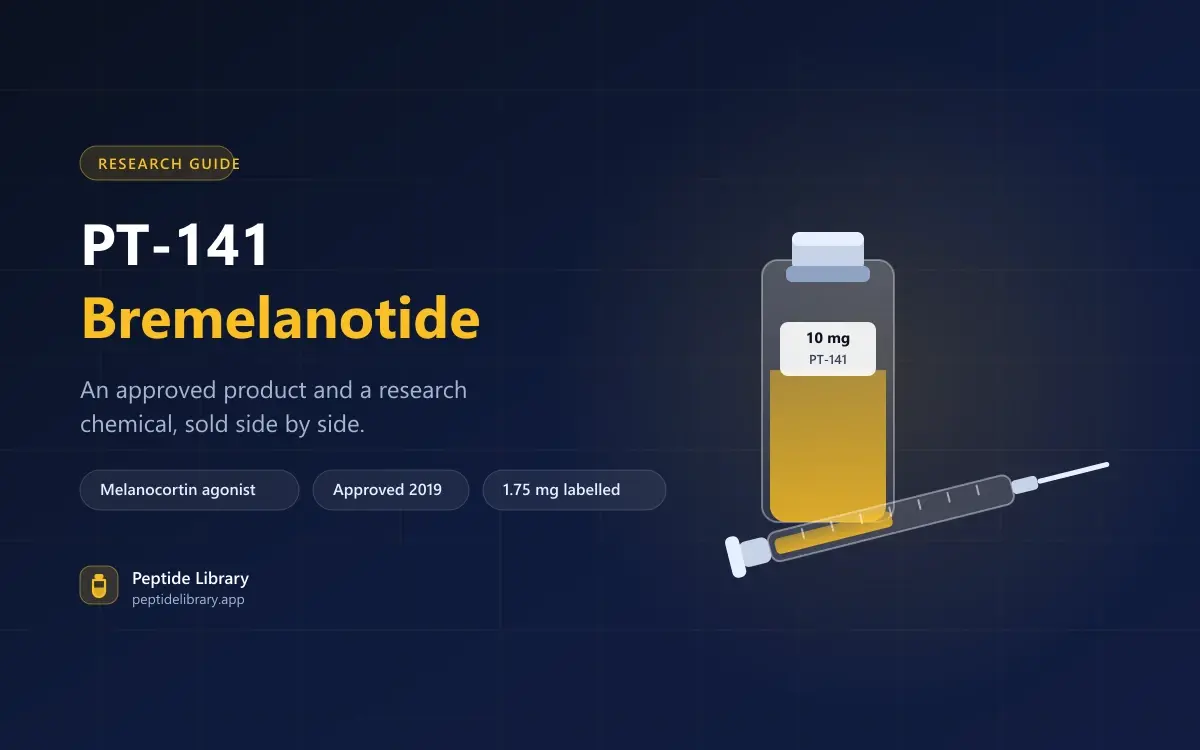
PT-141 is bremelanotide, approved in the US in 2019 as Vyleesi for hypoactive sexual desire disorder in premenopausal women. The labelled dose is 1.75 mg by subcutaneous autoinjector, taken as needed rather than on a schedule.
It is simultaneously sold as a research chemical in multi-milligram vials. Those two things share a molecule and very little else — different manufacturing, different quality assurance, and a labelled dose that applies to one population studied under supervision.
An approved dose is indication-specific. 1.75 mg is the figure for one condition in one population, established under trial conditions. It is reference information, not a general-purpose number, and it does not transfer to research-grade material of unverified content.
How it works
PT-141 is a melanocortin receptor agonist. Unlike PDE5 inhibitors, which act on the vascular system, it acts centrally on pathways in the brain involved in sexual desire — a different mechanism addressing a different part of the problem.
It is a metabolite of melanotan II, which is why the two are related and why some of the same side effects appear. Bremelanotide was developed specifically for this indication rather than for pigmentation.
Reported side effects
The trial programme reported a consistent profile, dominated by:
Nausea, the most common effect and the most frequent reason for discontinuation in trials.
Flushing and headache.
Injection site reactions.
Transient blood pressure changes — a small increase with a compensatory heart rate decrease, which is why the label addresses cardiovascular considerations.
Focal hyperpigmentation with repeated use, reflecting melanocortin receptor activity.
The vial math
Research vials are typically 10 mg — several times the labelled single dose — so concentration choice matters a great deal here.
Vial | BAC water | Concentration | 1 mg | 1.75 mg |
|---|---|---|---|---|
10 mg | 2 mL | 5 mg/mL | 20 units | 35 units |
10 mg | 3 mL | 3.33 mg/mL | 30 units | 52.5 units |
10 mg | 5 mL | 2 mg/mL | 50 units | 87.5 units |
A 10 mg vial holds roughly five to six times the labelled single dose. Because PT-141 is used as needed rather than daily, a reconstituted vial can easily outlive the 28-day beyond-use window before it is finished — which is a reason to think about diluent volume and vial size together rather than separately.
The peptide calculator converts any vial and target into units.
Storage
Storage is the same as any reconstituted vial: 2–8 °C, protected from light, never frozen, and bounded by the shorter of peptide stability and the 28-day limit on bacteriostatic water. The bacteriostatic water guide covers the detail.
Frequently asked questions
Is PT-141 the same as Viagra?
No. PDE5 inhibitors act on blood flow; PT-141 acts on central melanocortin pathways. Different mechanisms, different targets.
Is it approved for men?
The US approval is for hypoactive sexual desire disorder in premenopausal women. Use outside that population sits outside the approval and the trial evidence.
Why does it cause skin darkening?
Melanocortin receptors are involved in pigmentation as well as sexual response, so activity at those receptors can produce both effects. It is the same receptor family that makes melanotan II a tanning compound.
Research and educational use only. Peptide Library is an independent research and comparison platform and does not sell peptides. Nothing here is medical advice, dosing guidance, or a recommendation to administer any substance to a person or an animal. Consult a licensed clinician for anything concerning human health.
Sources
Author
Peptide Library Editorial
Editorial content from Peptide Library. Research and educational use only. Not medical advice.
Related articles
Related peptides
Related tools
Research smarter with Peptide Library.
Compare peptides, review vendor data, and use research calculators in one place.
Explore the LibraryResearch and educational use only. Not medical advice. Peptide Library does not sell peptides.