Peptide Research
KPV Peptide: The Anti-Inflammatory Fragment of a Pigmentation Hormone
KPV is the last three amino acids of alpha-MSH — the part associated with anti-inflammatory signalling, separated from the part that causes tanning. That separation is the entire interest.
Peptide Library Editorial · April 14, 2026 · Updated August 30, 2026 · 3 min read
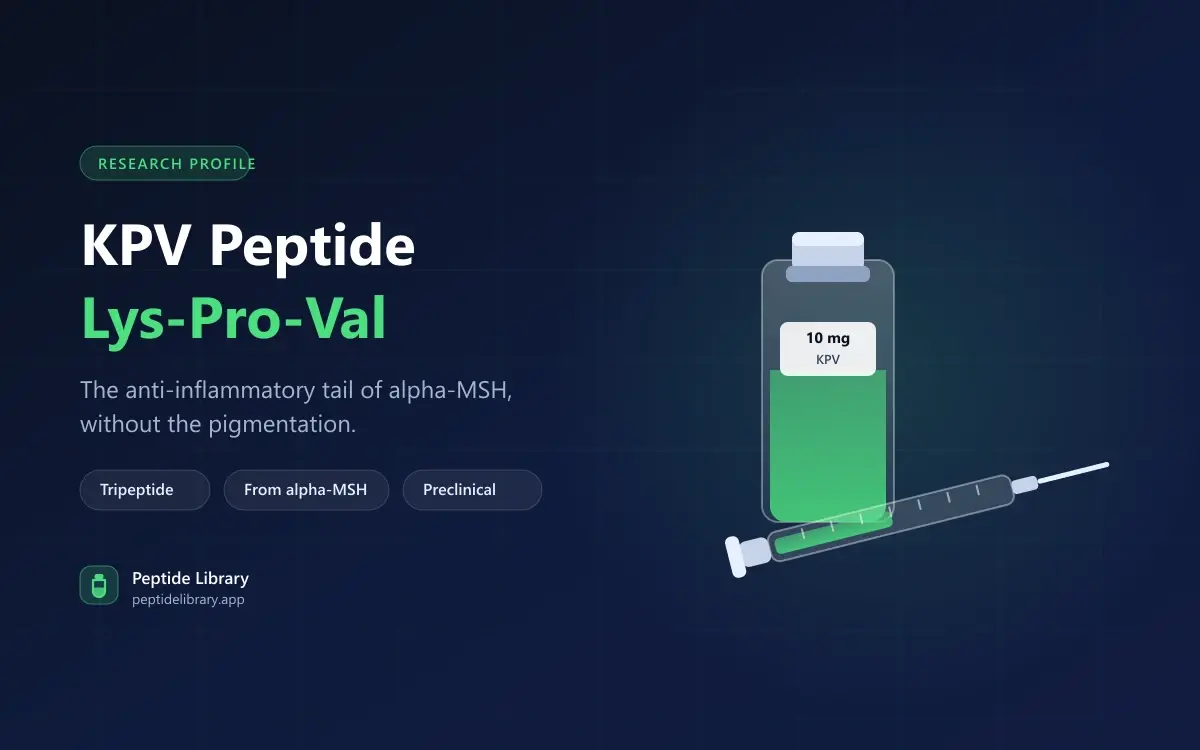
KPV is three amino acids: lysine, proline, valine. It is the C-terminal fragment of alpha-melanocyte-stimulating hormone — the last three residues of a thirteen-residue hormone.
The interesting part is what gets left behind. Alpha-MSH drives pigmentation and has anti-inflammatory activity; KPV retains the anti-inflammatory association without the melanocortin receptor activity responsible for tanning.
Not an approved drug. KPV has no approved human indication and no established human dose. It is sold for laboratory research only, and nothing here is dosing guidance.
The fragment logic
This is the same reasoning behind AOD-9604 — isolate the part of a molecule responsible for the effect you want, discard the rest. Here the aim is anti-inflammatory activity without pigmentation.
The contrast with melanotan II is instructive: both derive from the same hormone family, and they were pulled in opposite directions. One keeps the pigmentation activity, the other discards it.
What the research covers
Inflammatory signalling. Work reports effects on NF-κB signalling and pro-inflammatory cytokine production in cell models.
Gut. Much of the interest concerns intestinal inflammation, where KPV appears in research on colitis models.
Skin and wound healing. It appears in the tripeptide wound-healing literature alongside GHK-Cu.
Human trials. No published human dose-ranging or efficacy trial establishes an effective or safe dose.
The literature is preclinical, and the same caution applies as everywhere in this category: cell and rodent models establish a mechanism worth investigating, not a human dose.
Oral versus injected
KPV appears in research using oral and topical delivery as well as injection, particularly in gut-focused work where local delivery to the intestine is the point.
Route matters more than usual here. A compound studied for intestinal inflammation via oral delivery is being studied for local action in the gut. Reading an injected-dose figure off that research skips the step that made the delivery relevant.
The vial math
KPV is supplied lyophilised, commonly in 10 mg vials, with figures discussed in the low milligram to microgram range.
Vial | BAC water | Concentration | 250 mcg | 500 mcg | 1 mg |
|---|---|---|---|---|---|
10 mg | 2 mL | 5 mg/mL | 5 units | 10 units | 20 units |
10 mg | 3 mL | 3.33 mg/mL | 7.5 units | 15 units | 30 units |
10 mg | 5 mL | 2 mg/mL | 12.5 units | 25 units | 50 units |
As always, more diluent gives larger and more forgiving unit readings for small targets. The peptide calculator handles any combination.
Storage
Storage is the same as any reconstituted vial: 2–8 °C, protected from light, never frozen, and bounded by the shorter of peptide stability and the 28-day limit on bacteriostatic water. The bacteriostatic water guide covers the detail.
Frequently asked questions
Does KPV cause tanning?
The fragment lacks the melanocortin receptor activity responsible for pigmentation in the parent hormone, which is the reason it was separated out.
Is KPV in the KLOW blend?
Yes — KPV is the component that distinguishes KLOW from GLOW, typically at 10 mg.
Is oral KPV equivalent to injected?
No, and they should not share a dose figure. Different routes mean different bioavailability and, for gut-focused work, a different intended site of action.
Research and educational use only. Peptide Library is an independent research and comparison platform and does not sell peptides. Nothing here is medical advice, dosing guidance, or a recommendation to administer any substance to a person or an animal. Consult a licensed clinician for anything concerning human health.
Sources
- 1. KPV attenuates adipogenesis and lipid metabolism through modulation of ROS-mediated AKT/mTORC1/PPARγ signaling — Tissue and Cell (2026) Source PubMed
- 2. Exploring the Role of Tripeptides in Wound Healing and Skin Regeneration: A Comprehensive Review — International Journal of Medical Sciences (2025) Source PubMed
Author
Peptide Library Editorial
Editorial content from Peptide Library. Research and educational use only. Not medical advice.
Related articles
Related peptides
Related tools
Research smarter with Peptide Library.
Compare peptides, review vendor data, and use research calculators in one place.
Explore the LibraryResearch and educational use only. Not medical advice. Peptide Library does not sell peptides.